AI Agent Design Frontiers
Introduction: The Current State and Direction of AI Agents
This report analyzes the system design and technological evolution of AI agents, with a focus on developments from 2024 through 2026. Drawing on foundational research from 2023 and primary documentation from major platform providers — OpenAI, Anthropic, Google, AWS, and Microsoft — we examine these trends from a practical engineering perspective.
Core Insight: From Monolithic Models to Composable Systems
The most significant paradigm shift in AI agent design today is the move away from "a single, all-purpose model" toward "composable, observable, and constrainable systems." Anthropic's 2024 engineering report draws a clear distinction between "Workflows" and "Agents," emphasizing that many successful implementations rely on simple composition patterns rather than complex frameworks.
Meanwhile, the platform roadmaps of the major players (OpenAI, Google, AWS, Anthropic) for 2025–2026 embed state management, tools, sessions, tracing, approval flows, and sandboxing as first-class citizens of their agent infrastructure.
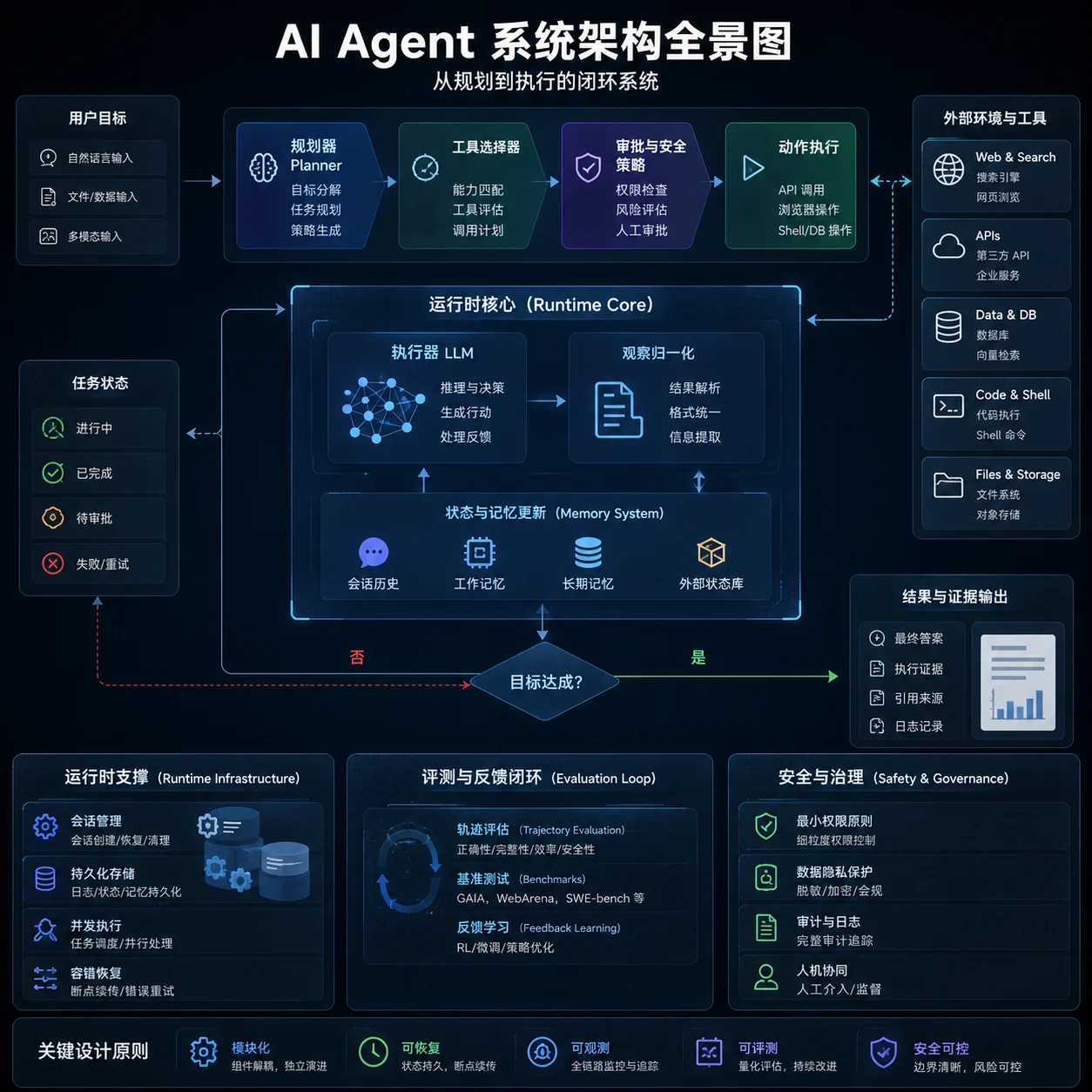
The Mainstream Implementation Pattern: Planner + Executor + Memory/Retrieval + Tools + Evaluation Loop
As the field transitions from research to engineering, the dominant architectural pattern is: Planner + Executor + Memory/Retrieval + Tools + Evaluation Loop.
- OpenAI recommends using reasoning models from the o-series as the "Planner" and deploying low-latency GPT models as the "Doer" (Executor).
- Anthropic treats the enhanced LLM as a base component that is extended by retrieval, tools, and memory.
- AWS and Google similarly separate action groups, knowledge bases, sessions, memory, and execution environments as distinct architectural elements in their product structures.
The Evaluation Metric Shift: From Final Answers to Execution Trajectories
The focus of evaluation has moved from simply "did it get the right answer" to "how did it get there — what was the trajectory?" Benchmarks like WebArena, OSWorld, GAIA, and SWE-bench Verified now comprehensively evaluate agent behavior logs across dimensions including web manipulation, GUI interaction, code editing, and function calling. Google Vertex AI has taken this further by explicitly modeling final-answer evaluation and process evaluation as separate concerns.
The Robustness Gap in Real-World Environments
That said, agent robustness in real-world environments still falls far short of human performance:
- On GAIA, while humans achieved an average accuracy of 92%, plugin-equipped GPT-4 managed only 15% at one point.
- VisualWebArena reports show the best VLM-based agents reaching just 16.4% success rates, compared to roughly 88.7% for humans.
- On Online-Mind2Web (2025), which tests more realistic web tasks, even state-of-the-art agents achieved only about 30% success, suggesting that existing benchmarks had been overestimating capabilities.
Where Value Is Actually Being Created
Yet in domains that are verifiable and provide feedback loops, agents are beginning to deliver substantial value:
- Software Engineering: OpenAI Codex executing coding tasks within isolated containers.
- Customer Support: Intercom reports AI-driven resolution rates reaching 90%.
- Legal: Thomson Reuters' next-generation CoCounsel Legal is being rebuilt on the Anthropic Claude Agent SDK.
- Infrastructure Optimization: Google DeepMind's AlphaEvolve has been deployed for data center scheduling and TPU design, recovering an average of 0.7% of compute resources.
Definitions and Classifications
From a practical standpoint, an AI agent can be defined as "a goal-oriented system that operates within a closed loop — observing, selecting actions, invoking tools, maintaining state, and adapting to new information through multi-step processes."
Five Dimensions of Agent Classification
| Dimension | Main Types | Significance | Practical Implications |
|---|---|---|---|
| Autonomy | Workflow → Semi-Autonomous → Fully Autonomous | From fixed paths to model-driven decision-making | Most enterprises start with workflows and only automate high-value nodes |
| Environment Modality | Text/API, Web, GUI/OS, Code, Physical Robot | Determines the interface for observation and action | GUI/Web scenarios are closest to practical use but also the most fragile |
| Action Space | Function Calling, OpenAPI, Browser Control, Shell, File Editing | Broader action scope = greater side effects | Approval flows, sandboxing, and least-privilege principles are essential |
| Memory Mechanism | Short-term Context, RAG/Semantic Memory, Episodic Memory, Skill Library | Determines long-task consistency and reusability | Memory goes beyond history storage — it includes compression, reflection, and retrieval strategies |
| Organizational Structure | Single Agent, Planner-Executor, Orchestrator-Worker, Multi-Agent Team | Defines module boundaries and coordination costs | The more complex, the greater the need for clear observation, role separation, and avoiding responsibility overlap |
Architecture Patterns and Core Components
The current mainstream architecture follows a three-layer structure: the Task Decomposition & Strategy Layer, the Capability Execution Layer, and the Operations & Governance Layer.
Key Architecture Patterns
- Planner–Executor: A powerful reasoning model creates plans while lighter models or tools handle execution. This balances accuracy with cost/latency trade-offs.
- Orchestrator–Worker: A top-level agent dynamically decomposes tasks and delegates to sub-agents. This pattern excels at handling unknown tasks and scaling.
- Evaluator–Optimizer: A generator and reviewer form a loop to iteratively improve outputs. Ideal for cases requiring high-quality output, such as code revision or legal document drafting.
A Next-Generation Engineering Concept: "Context Engineering"
Defined by Anthropic in 2025, this concept describes "the art and science" of continuously curating and refining a limited context window. Rather than simply stuffing tokens, the key decisions become: what to retain, what to compress, what to forget, what to re-retrieve, and what to externalize as tools or memory. This has elevated mechanisms like Prompt Caching and episodic memory from mere techniques to explicit architectural elements.
Algorithm Evolution: From Simple Reasoning to Closed-Loop Strategy
The evolution of algorithms can be distilled into three axes:
- Externalizing Reasoning and Exploration: Moving from Chain-of-Thought (CoT) to branching exploration and backtracking methods like Tree of Thoughts and LATS.
- Feedback and Self-Correction: Iterative improvement through self-feedback mechanisms like Self-Refine and Reflexion.
- Interactive Environment Learning: Shifting from single-answer optimization to trajectory-and-outcome-based strategy optimization, as seen in WebRL and STEP-HRL.
Particularly noteworthy is the shift in reinforcement learning's focus from preference alignment (Alignment) to environment adaptation (Adaptation). In complex environments like web and GUI interaction, SFT and DPO alone are insufficient — learning grounded in actual execution outcomes becomes indispensable.
System Engineering and Evaluation Maturity
Agent systems have coalesced into a "new backend discipline" independent of foundation models. This includes recoverable execution (durable execution), asynchronous long-running tasks, stateful sessions, container isolation, and detailed tracing as standard requirements.
Strategies for Solving Latency and Scalability
- Planner/Doer Separation: Concentrate intellectual resources at critical decision points.
- Parallelization: Execute independent sub-tasks concurrently.
- State Compression and Caching: Improve efficiency through prompt caching and compact context management.
- Asynchronous Execution: Process long-running tasks in background sessions.
Conclusion: The Future of AI Agents
Over the next 2–5 years, the competitive frontier will shift from "who produces better answers" to "who can execute actions safely and reliably within real-world systems."
This means success won't simply come from scaling up base models. It requires holistically advancing:
- Protocol-layer interoperability (MCP, A2A)
- Runtime isolation and memory governance
- Tool management built on least-privilege principles
- Trajectory-level evaluation and prompt injection defense
AI agents have evolved from being "an extension of prompt engineering" into a "new application system stack." The pace at which this stack is maturing is outstripping the rate of progress toward fully autonomous, general-purpose agents.
Loading...