Beyond the Model
The AI community is finally shifting its focus. For a long time, the conversation around Agents centered almost exclusively on the underlying model. The prevailing logic was simple and linear: larger parameters equal smarter agents; longer context windows allow for more complex tasks; and more external API tools expand the agent's capabilities.
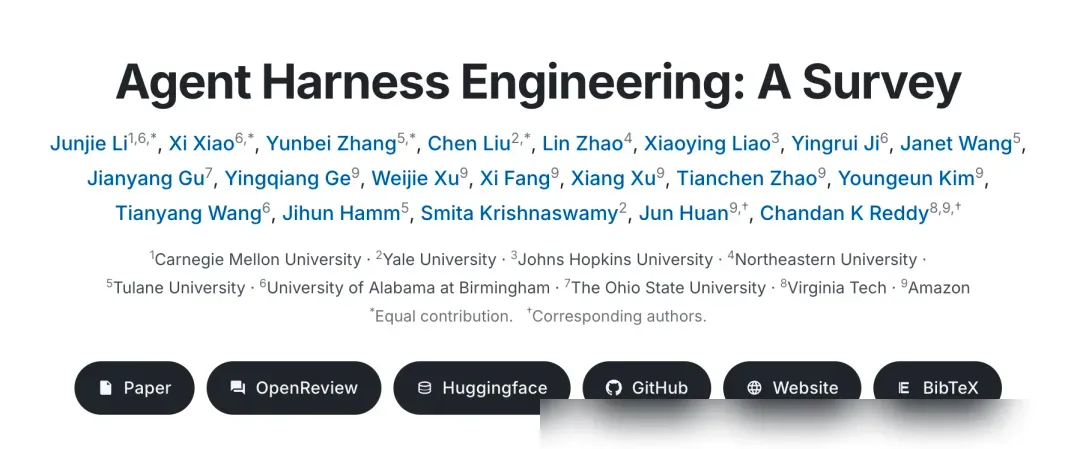
However, recent research—including a comprehensive review on Agent Harness Engineering from institutions like CMU and Yale—signals a critical shift in consensus: the reliability of an LLM-based Agent cannot be solved by looking at the model alone.
Why Stronger Models Still Fail
Any developer who has worked on long-horizon tasks knows that when an Agent crashes, it is rarely because it suddenly lost its ability to reason. Instead, it's usually because the system lacks a stable runtime structure.
Typical failure modes include:
- Quietly forgetting the primary objective of the current task.
- Writing a hallucinated inference into its long-term memory as a hard fact.
- Failing to update the "world state" after executing a destructive tool.
- Confidently charging down a wrong causal path after a single fatal misjudgment.
These system-level collapses cannot be fixed by upgrading to a trillion-parameter model or stuffing 1M tokens into a context window. An industrial-grade Agent is not just a model plus a system prompt or a few function calls; it is a complex operating system consisting of a model, state machines, memory streams, execution sandboxes, validators, monitoring traces, and recovery strategies.
Transitioning from Harness to State-Aware Runtimes
While Harness Engineering provides a necessary map of the components required to support an agent, it primarily addresses a static question: "What components make up the agent's peripheral system?"
The more critical, dynamic question is: "How do these components collectively maintain a long-term stable, auditable, rollback-capable, and recoverable execution state?"
I define this direction as the State-Aware Runtime.
A State-Aware Runtime doesn't just add "memory" or append history to a prompt. Instead, it models every step of the Agent's execution as a verifiable state transition. The system must explicitly know the current state, distinguish between candidate actions and committed actions, and determine which states can be rolled back or isolated for human intervention.
1. Maintaining State Transitions
In long-horizon agents, the core is high-frequency state transitions. Every cycle is more than just generating the next token;
The most dangerous scenario isn't a model providing a wrong answer—it's the system not knowing its own state. Which facts are immutable constants? Which are temporary session contexts? Which actions have been permanently written to a database? Without explicit state management, an Agent is merely a text generator that looks smart but suffers from internal state conflicts.
2. Context Window $
eq$ State Management
There is a common misconception in the industry that expanding the context window solves memory issues. However, long context is not the same as long-term state management.
Brute-forcing tens of thousands of words of history into a prompt can actually be counterproductive. Early strict constraints can be overwritten by middle-of-the-conversation chatter, and temporary speculations can be solidified as truths. While "Context Engineering" asks how to get the right info into the prompt, a State-Aware Runtime asks: "What is the current state? Who has the right to modify it? How do we isolate and recover polluted states?"
3. The Danger of Committed Errors
In traditional LLM benchmarks like MMLU, we only care about the final answer. For Agents, this is useless because failures are cumulative and exhibit cascading propagation.
If a model misinterprets user intent but the judgment remains in a "candidate text" phase, a simple retry can fix it. But if that misinterpretation is written to long-term memory, every subsequent planning step collapses. Similarly, a dangerous API call intercepted by a validator is a non-event; a call that actually modifies a database is a physical pollution of the external state.
Reliability in long-horizon agents is not about forcing the model to be perfect, but about building rigorous boundary defenses that strictly separate candidate outputs from committed states.
4. Moving Toward Trace-Native Evaluation
We are surrounded by "perfect" demos where agents autonomously solve tasks. However, for high-reliability systems, a real failure trajectory is far more valuable than a successful demo.
By dissecting the Trace, we can identify whether a crash was due to a missing state projection, a broken tool chain, or a validator that was too lenient. This is why Trace-Native Evaluation is essential. We shouldn't just ask if the task was completed, but how the result was generated, whether intermediate states were polluted, and if the system could precisely locate the error to perform a recovery.
A New Research Frontier for Independent Developers
For those without massive compute clusters, the State-Aware Runtime is a fertile ground for research. While big labs compete on GPU arrays and benchmark leaderboards, this field requires sensitivity to system failure and patience for analysis.
Independent researchers can build significant moats by focusing on:
- Procedural Fidelity: The gap between a correct answer and a faithful process.
- Epistemic Memory: Managing what a character knows, forgets, and remembers in long-form narratives.
- State Drift: Analyzing how agents deviate from intended world-states in gaming or simulation environments.
- Failure Taxonomy: Building a comprehensive catalog of how agents collapse.
While big tech focuses on how to make models do more things right, the real opportunity lies in studying how to ensure a system doesn't destroy everything when it inevitably does something wrong.
Conclusion: The Second Half of the Agent Race
Models will continue to get stronger and context windows will keep expanding. But the ultimate industrial bottleneck won't be "intelligence"—it will be the ability to maintain internal state consistency in a chaotic external environment.
In this equation, the model generates possibilities, the Harness provides the physical constraints, and the State-Aware Runtime ensures consistency, audits the process, and prevents catastrophic commits.
The winner of the next generation of AI Agents will be whoever can safely wrap these powerful yet unstable models into an auditable, recoverable state-machine system.
Editor's Take
'It's not just about the model' aligns with real-world developer intuition. Harness Engineering's importance is intuitively understood by many, but lacked a formalized framework. This paper's significance is providing that framework.
Loading...