ChatGPT's Biggest Overhaul Yet
The era of using AI just for chat is over.
On June 7, the Financial Times reported that OpenAI is preparing the largest redesign of ChatGPT since its 2022 launch, with changes rolling out over the coming weeks. The core move: folding OpenAI's fastest-growing coding tool, Codex, directly into ChatGPT and integrating third-party apps — effectively transforming a chatbot used by nearly a billion people into a "super-app" that writes code, manages schedules, and operates software on your behalf.
"The era of AI being used only for chat is over," a senior OpenAI employee told the FT, capturing the company's strategic pivot in a single sentence.
Inside OpenAI, leadership has converged on a shared conviction: AI's future lies not in answering questions but in acting as an intelligent agent that runs errands and gets work done. ChatGPT is being repositioned — from a conversational tool into a massive traffic gateway. The real revenue and valuation story hides behind it: coding infrastructure and enterprise services.
Thibaut Sottiaux, the executive overseeing all of OpenAI's core products and platforms, described the end-state: "You connect to it from your phone, desktop, or the web. When you're in your car, you talk to it." The intent is unmistakable — make the agent omnipresent, genuinely completing tasks in users' lives and workflows, and monetize that utility.
Whether OpenAI will dominate the next chapter of AI applications remains an open question. Anthropic, Google, and xAI (now folded into SpaceX) are all doubling down on model capabilities, application surfaces, compute resources, and ecosystem lock-in.
Codex Takes Over: Coding Tools Reshape the Super-App Entry Point
Alex Embiricos, OpenAI's enterprise product lead, explained the Codex-into-ChatGPT strategy as a phase-two move. "We now have agents that can do anything on a computer. The next goal is to push that capability to everyone."
To pull Codex out of its programmer-only niche, OpenAI has already launched six role-specific plugins covering creative production, sales workflows, and public stock investing.
For everyday users, the most visible changes will appear in the UI over the coming weeks. Early iterations of the redesigned ChatGPT — both web and mobile — will be loaded with prompts and feature entry points steering users toward coding tools, image generation, or apps built by external partners like Canva and Booking.com.
In the near term, users will see a toggle letting them manually choose whether Codex or ChatGPT handles a request.
Embiricos outlined several automation scenarios that non-technical users could adopt immediately:
- Email and Slack integration: Dictate a message, and Codex drafts it, matches the recipient, and sends it with one confirmation click.
- Calendar-connected queries: Ask aloud what's on your schedule or retrieve meeting context on demand.
- Scheduled daily briefings: Set up an 8 a.m. routine that pushes a summary of the day's meetings and the most urgent items from your inbox.
But Sottiaux envisions something bigger. He believes the transitional phase won't last long. In the long run, the model will autonomously decide whether a task runs locally on the user's device or in the cloud — users won't need to think about which tool is doing the work.
Over time, the guided prompts and feature tiles will fade away. OpenAI is betting that its models will infer user intent naturally as people interact with apps and websites. Some observers have noted this sounds like the beginning of a transition toward AGI — and that dropping prompt scaffolding likely means better voice-first interfaces, where you simply speak and the agent acts.
The Engine Under the Hood: Model Upgrades
The experience shift is powered by changes most users will never see. To get the public comfortable with an "assign tasks" paradigm, the underlying production toolchain had to be rebuilt from the ground up — and that toolchain is Codex.
The deepest driver is model improvement. GPT-5.5, released in April, handles long-horizon, multi-step tasks far better than its predecessors, requiring far less human guidance. This gave Codex real confidence to execute independently once given a clear brief. As Basis co-founder Mitch Trojanowski put it, "By GPT-5.5, the Codex advantage had become impossible to ignore."
Stronger models bred developer trust. An informal consensus emerged: when you have a well-defined plan, hand the whole job to Codex and let it finish.
Notion engineer Varun Rao shared a telling detail — every time he and his colleagues ran Codex during tool development, it silently patched a code vulnerability. They only discovered the bug had existed for weeks when they switched to a different agent.
Trust alone isn't enough; accessibility matters too. The February launch of the Codex desktop app hit that sweet spot. Previously, Claude Code was only available through a pure command-line terminal — a steep barrier for non-technical users. The desktop app added a graphical interface that brought ordinary users into the fold, while power users running multiple agents simultaneously found it equally smooth.
Notion product lead Max Schoening particularly liked the workflow of launching tasks on his desktop and checking progress on the Codex mobile app.
The data tells the story best.
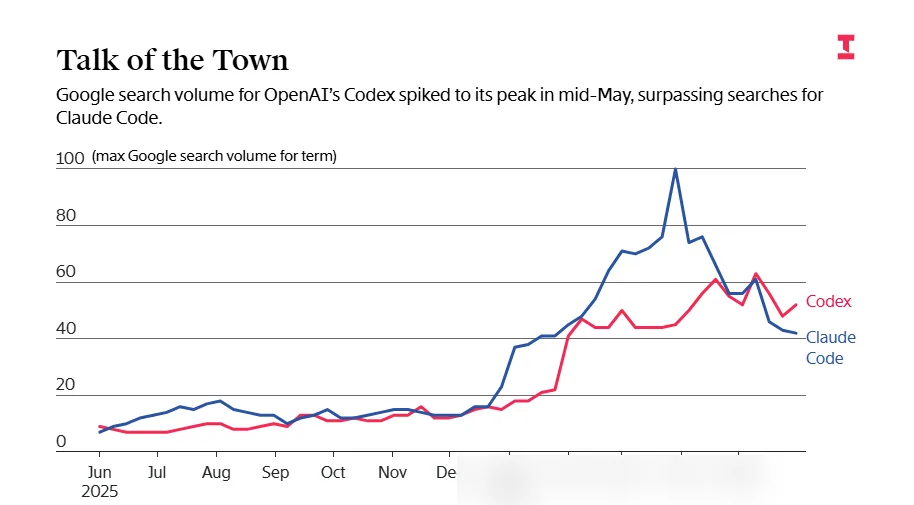
Since the desktop app launched, Codex's user base has grown sixfold in under two months, and weekly active users crossed the 5 million mark by late May. Google search interest for Codex hit an all-time high in mid-May, surpassing Claude Code.
CEO Sam Altman recently disclosed at an all-hands meeting that Codex usage is growing at 5% per day. Co-founder and president Greg Brockman told employees last month that Codex revenue from enterprise customers is up 50% week over week.
Forced Into Overdrive by Anthropic
OpenAI's dramatic strategic pivot was, to a large degree, forced by Anthropic.
The rivalry ignited in autumn 2024, when internal benchmarks showed Anthropic's models had overtaken OpenAI in coding ability. By February 2025, when Anthropic officially launched the preview of Claude Code, OpenAI realized it had been leapfrogged by a much smaller competitor in a critical domain.
For OpenAI, falling behind in coding was existential. The company has long held that AI-powered coding will accelerate the core research needed to build superintelligence. Losing the coding race means losing position on the road to AGI.
Jenny Shaw, a former OpenAI researcher now at Leonis Capital, observed: "About a year ago, OpenAI's strategy was 'full steam ahead' while Anthropic was 'revenue first.' Now both paths are converging because both companies are eyeing IPOs, and investors care more about monetization than moonshots."
To reclaim lost ground, OpenAI fast-tracked a dedicated Codex R&D team led by Sottiaux himself. The team was granted unusual autonomy and even took the unprecedented step of open-sourcing Codex's underlying code to harvest direct user feedback for improvements.
The Codex team's success triggered a broader organizational overhaul. In January, OpenAI restructured to embed product teams alongside foundational model researchers. By May, the restructuring reached its climax: OpenAI merged the ChatGPT, Codex, and API teams into a unified Core Products & Platforms division under Sottiaux.
In this resource reallocation, some consumer-facing projects became casualties. A planned ChatGPT shopping checkout feature was shelved. Sora, the video generation product launched less than a year ago, was shut down entirely. The strategic signal is clear: deprioritize hard-to-monetize consumer products and funnel resources toward enterprise customers willing to pay.
IPO Looming: Making the Revenue Math Work
Every technical integration, organizational reshuffle, and product trade-off ultimately serves one purpose: strengthening the revenue picture ahead of an IPO.
Roughly 2 million enterprises using OpenAI products currently account for about 40% of revenue. The company expects that share to reach 50% by year-end. Codex will be central to that push — the majority of Codex users are paid subscribers.
Yet the competitive pressure remains acute. Riding Claude Code and Claude Cowork's explosive monetization in developer and enterprise segments, Anthropic's annualized revenue hit $4.7 billion in May. OpenAI, which last disclosed $2.5 billion in annualized revenue in March (with some reports now placing it above $3 billion), still faces a gap.
That's precisely why OpenAI is rushing to surface Codex to ChatGPT's 900-million-plus consumer user base. Even a marginal uplift in per-user willingness to pay, multiplied across that scale, would generate a torrent of cash ahead of the listing.
The technology roadmap reinforces the revenue logic. In January 2025, OpenAI launched Operator, an agent designed to let AI browse the web like a human — booking tickets, shopping, and so on. Leadership quickly concluded that simulating human mouse-clicks across web pages was hopelessly inefficient. Sottiaux acknowledged that writing code directly is a far more effective way for AI to accomplish tasks like building complex spreadsheets on a computer.
That pivotal judgment elevated Codex from a coding assistant to a general-purpose agent-building platform — and it explains why this super-app integration is viewed as a critical step toward a universal agent, mirroring Anthropic's own trajectory from Claude Code to the broader Claude Cowork.
The super-app blueprint is laid out. The operating-system-level ambition is unmistakable. But the most pressing question sitting on Sam Altman's desk remains unanswered: will hundreds of millions of consumers accustomed to free chitchat ultimately open their wallets for a digital agent that does their work and earns them money?
The high-stakes bet that will define the standards and power dynamics of the AGI era has only just begun dealing its cards.
Loading...