Kimi K3
Overnight, Kimi K3 has finally been officially unveiled. With 2.8 trillion parameters and a million-token context window, it represents a monumental step forward. 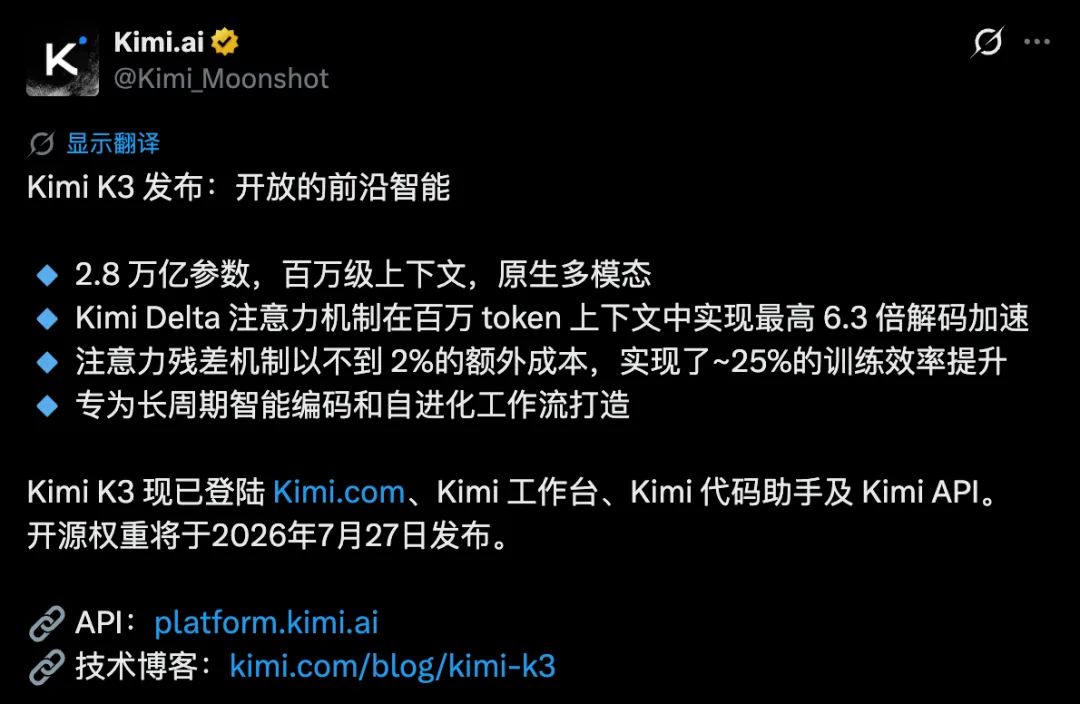 Furthermore, the official announcement states it will be fully open-sourced on July 27th. There's not much more to say—let's celebrate this moment together.
Kimi's parent company, Moonshot AI, posted a teaser yesterday afternoon. Interestingly, it paid homage to the shooting techniques of Claude's "Fable 5" model, hinting that in their eyes, this is a model that will prove itself and launch the company into a new era. 
If we say Zhipu AI is a master of post-training, elevating the GLM-5 series to new heights, then in my mind, the undisputed leader in pre-training domestically has always been Kimi. They've consistently been the poster child for massive parameter counts. Their K2 model, launched a few months ago, was the first in China to push a model to the trillion-parameter tier.
Many used to claim the Scaling Law for large models was hitting a ceiling, that it was becoming ineffective. Yet now we see that "bigger is still better, bigger is still smarter." It's much like how I still believe Claude Opus 4.6 is the most well-rounded "white moonlight" model in my heart—excelling in writing, creativity, cognition, agents, and coding—because that was a 5-trillion-parameter model. The subsequent Opus 4.7 and 4.8 took a hard left turn with reinforcement learning, boosting coding ability but severely degrading creativity and planning, leading to a clear decline in reputation...
As for the current king, Claude Fable 5, its exact parameter count remains unknown. However, based on discussions and speculation with some friends, it may be at the 10-trillion-parameter level, as the highest-parameter model Grok is currently training internally is also at that tier.
Looking back domestically, after Kimi, DeepSeek V4 Pro and Meituan's LongCat 2.0 have also stepped into the trillion-parameter realm. Gradually, trillion-parameter models are becoming the new standard.
And today, Kimi K3 is here. This time, they've pushed the parameter count to the 2.8-trillion level—China's first model in the 3-trillion-parameter class, and more importantly, the world's first 3-trillion-parameter model to be open-sourced for everyone. This is a moment of pride for Kimi.
As is tradition, let's look at Kimi K3's benchmark scores. Starting with the AA Intelligence Score, Kimi K3 lands in third place, behind only Fable 5 and GPT-5.6 Sol, surpassing all other models. 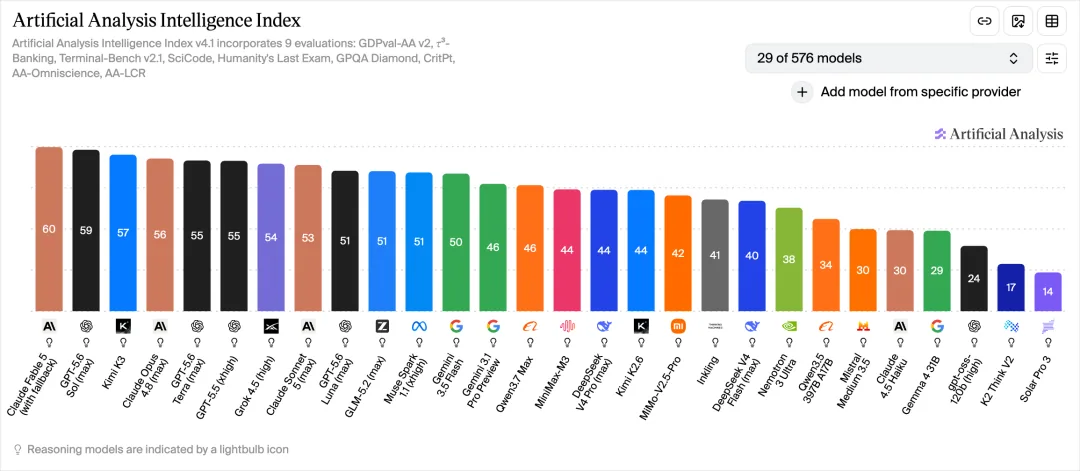 This essentially positions Kimi as the new "top three," replacing Google.
Now, let's look at Coding. 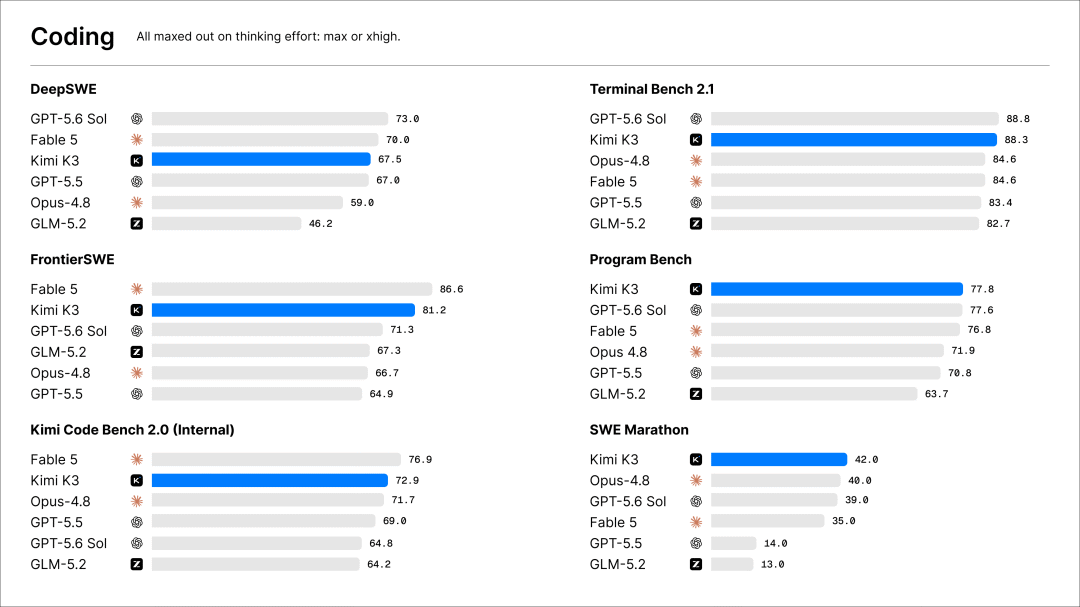 I'd like to use this opportunity, combining these benchmarks with my own experience, to briefly explain how to understand a model's "personality" and characteristics.
Every model has its own strengths and weaknesses. Even a titan like Fable 5 has shortcomings; it's just that its weak points are stronger than many models' best points.
Let's start with coding, which involves six benchmarks we can split into two categories.
The first category I call "precise execution." These benchmarks test whether a model can accurately complete a well-defined task, no more, no less, without missing steps or introducing errors. Think of it as your boss giving you a very clear checklist of exactly what needs to be changed. These tasks test precision and execution: understanding requirements, locating issues, making precise fixes, and not introducing new bugs.
DeepSWE and Terminal Bench 2.1 are classic examples, one leaning towards pure execution and the other towards comprehensive execution. 
GPT-5.6 Sol took first place in both of these. Its stability in requirement understanding, environment operation, debugging convergence, and final delivery is unmatched, which aligns perfectly with my daily usage experience. As for Opus 4.8, its hallucination rate is too high—I've criticized it many times. This ranking also matches my experience. 
Kimi K3, in terms of execution precision, came in second to Claude Fable 5 and GPT-5.6 Sol on DeepSWE. On Terminal Bench 2.1, it even secured the second-place spot.
The second category is the opposite, which I call "solution planning." FrontierSWE, for instance, tests frontier-level, extremely difficult software engineering problems that require creative thinking and deep understanding of complex systems to solve. 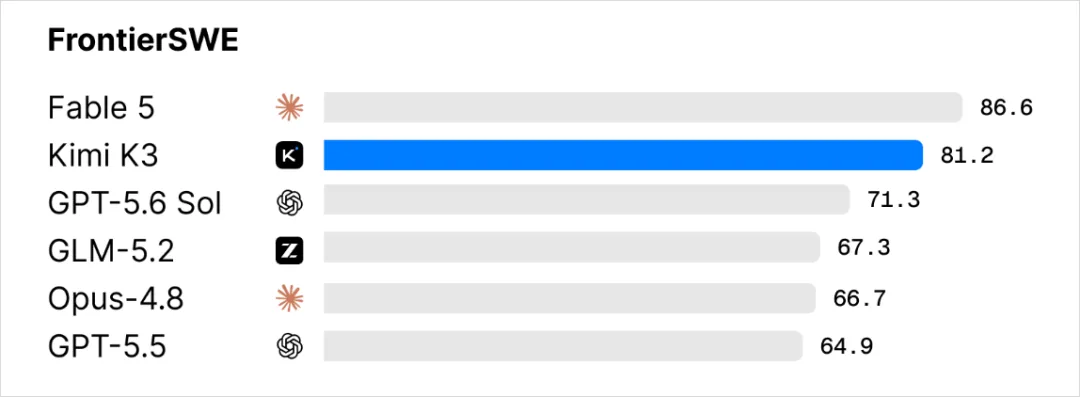
Fable 5 is simply in a league of its own, leading by a huge margin. GPT models, as we know, have consistently performed poorly on creative tasks and solution design—it's a known weakness. This time, Kimi K3 has directly inserted itself right between Fable 5 and GPT-5.6 Sol.
From this, we can see Kimi K3's positioning: a very balanced, "well-rounded" model. It's good in all areas. While it may not beat the absolute best in any single domain, it consistently ranks second or third. Honestly, such a well-rounded model might offer a better overall experience in daily use. I often find myself switching between Fable 5 and GPT-5.6 Sol—one for planning, one for execution—which is the current strongest combo but also a hassle... Let alone the fact that many people in China can't even access Fable 5.
Some overseas voices claim Kimi is relying on distillation. But let's be real, at this scale, it's not something distillation can produce. Even Lambert seemed to have had enough, responding directly like this... 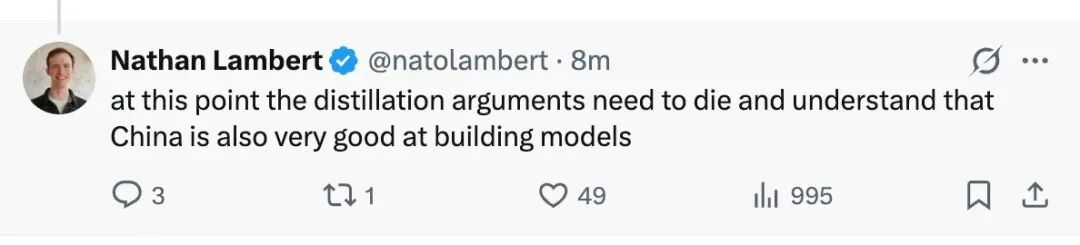 I find it very telling.
Now, let's look at the Agent capabilities many are more interested in, which are strongly correlated with work applications. 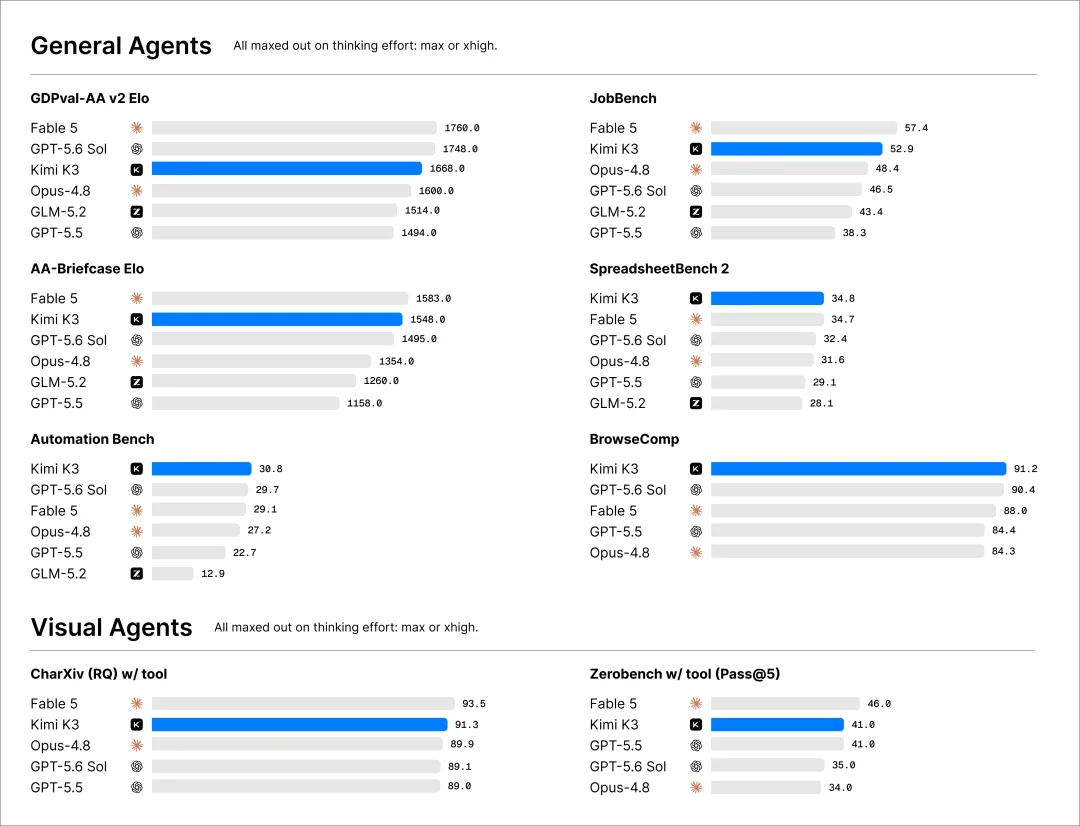
BrowseComp tests complex information understanding and processing in a browser environment—essentially deep research. You can think of it as "give the model a browser and let it find information, understand content, and complete tasks online." K3 scored 91.2, placing first overall, with GPT-5.6 Sol close behind at 90.4 and Fable 5 at 88.0. This has always been Kimi's forte; anyone who's used their cluster would have felt its power. 
Automation Bench tests the ability to execute automated tasks, chaining a series of operations together. K3 also came in first with a score of 30.8. SpreadsheetBench 2 tests spreadsheet handling—formulas, data cleaning, report generation. K3 is once again first with 34.8, narrowly beating Fable 5's 34.7.
Next are three comprehensive Agent tasks.
AA-Briefcase Elo is a comprehensive Agent Elo score covering various office scenarios. K3's 1548 places it second, behind only Fable 5's 1583. JobBench tests the ability to complete specific work tasks. K3's 52.9 is also second, again behind Fable 5. GDPval-AA v2 Elo is another comprehensive Agent scoring system. Fable 5 leads with 1760, followed closely by GPT-5.6 Sol at 1748. K3 comes in third with 1668—this is one of the few benchmarks where K3 falls behind GPT-5.6 Sol, though the gap is now quite small.
From these comprehensive Agent benchmarks, we can see that overall, K3 is still slightly behind Fable 5 but on par with GPT-5.6 Sol, with each model winning some and losing some.
Multimodal capabilities also deserve a mention. 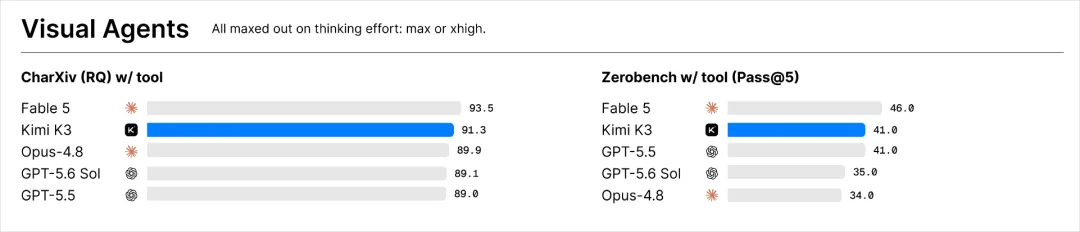 Kimi's multimodal performance is excellent domestically, ranking second only to Fable 5, which remains incredibly strong.
There's suddenly a sense of pride. In the past, saying a domestic model could compete with Opus 4.7 (let alone 4.8) would have been seen as a big deal. Today, we find that a domestic model can actually go toe-to-toe with GPT-5.6 Sol. The shadow of Fable 5 no longer seems so distant.
Of course, GPT-5.6 Sol has its own characteristics—it's still an older model enhanced through methods, not a brand-new pre-trained model like Fable 5 and Kimi K3. Who knows how monstrous GPT-6 will be when it arrives.
If you previously couldn't use Claude or GPT and were limited to domestic models, I highly recommend you start using Kimi K3 for all your work today to experience the intelligence of a next-generation 3-trillion-parameter model.
At the same time, I hold no illusions about the domestic computing power landscape. Models of this size present a massive challenge for Kimi in terms of inference cost. So I think now is the time to grab a Kimi Coding Plan—I have a feeling it will become unavailable soon, much like GLM's plans did...
Honestly, I rarely pay for domestic models. Kimi K3 is one of the few I've been willing to "pay respect" to upfront. I have the 699 yuan membership and ran it all night through various test tasks and multi-agent real-world development, burning through a lot of tokens. You can use this as a reference. 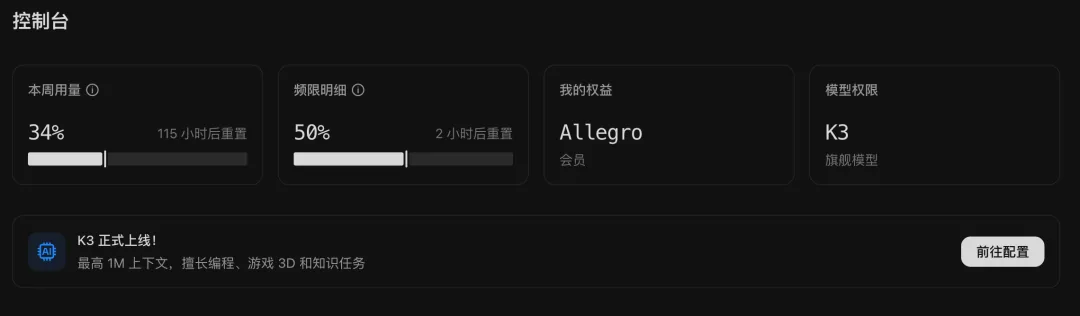
In real-world testing, it did not disappoint. My experience almost perfectly aligns with the benchmark scores Kimi released. It's a comprehensive model—good across the board. It may not deliver the "divine touch" that Fable 5 often does, but you can comfortably entrust it with your projects and plans.
For this round of testing, I didn't use Claude Code. I believe that in today's era, a model paired with a harness framework forms a complete product. And your own model paired with your own framework is undoubtedly the best match. So this time, I ran Kimi K3 using Kimi Code.
A quick aside: Kimi Code does have a graphical interface version, though they haven't built a client like Codex yet—it's still just a web version. 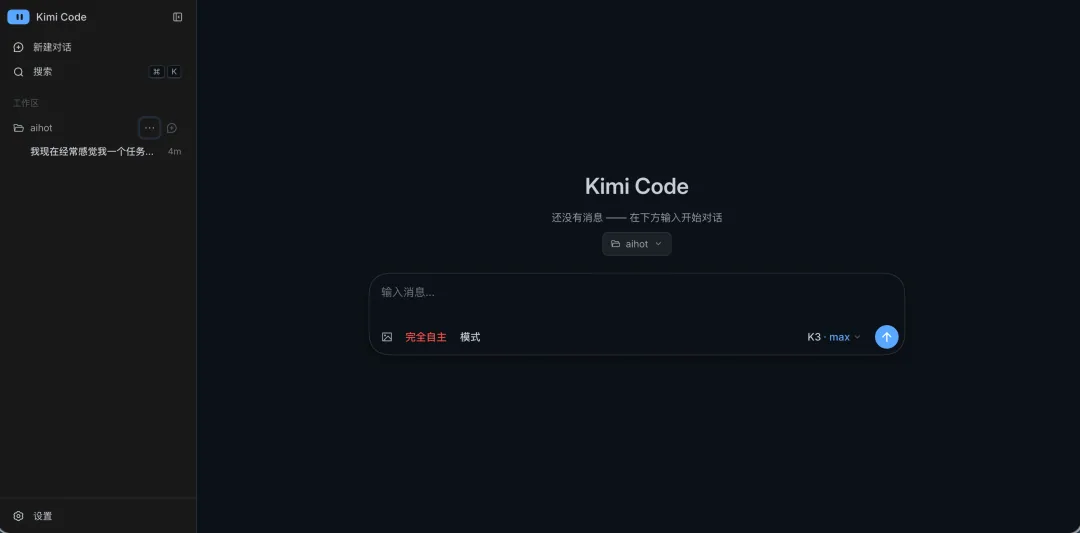 Opening this interface is simple: just type
 kimi web in the terminal to launch it.  Honestly, after getting used to the Claude and Codex clients, I really don't want to go back to a CLI interface—it just feels awkward.
Kimi K3 also brings a significant update: the context length has finally reached 1 million tokens.  This is a great improvement; a million tokens is pretty much the new standard.
The first thing I asked it to do was fix a bug on my own site, AIHOT. For some reason, AIHOT hadn't picked up the blog post about Kimi K3's release. So I asked Kimi K3 to fix the issue of it not scraping its own announcement and find the bug... 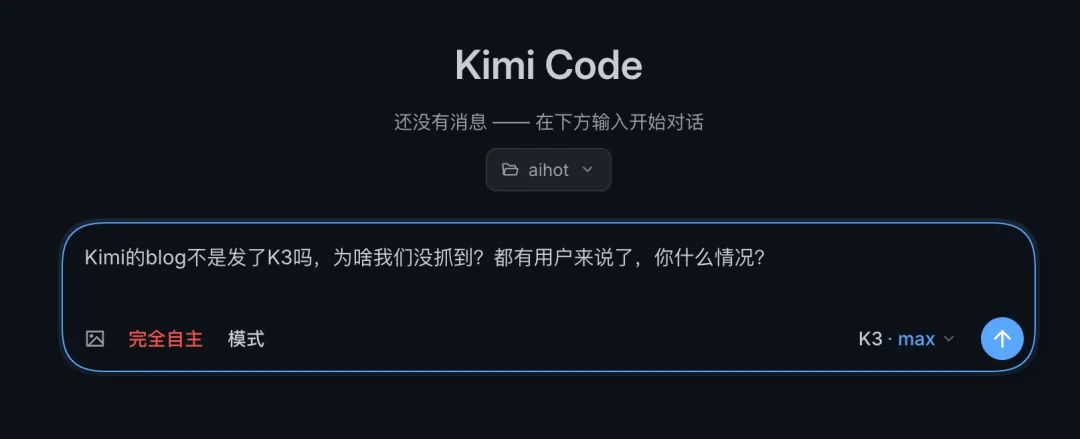
I sent the request, and it immediately got to work. 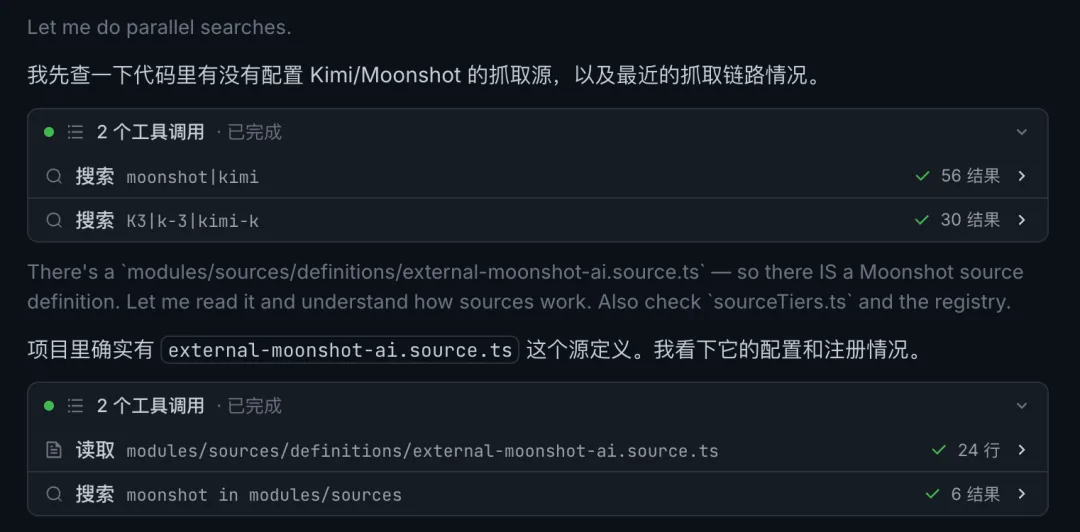 It quickly discovered the cause: Kimi's own official blog had been redesigned, and it happened just a couple of days ago.
 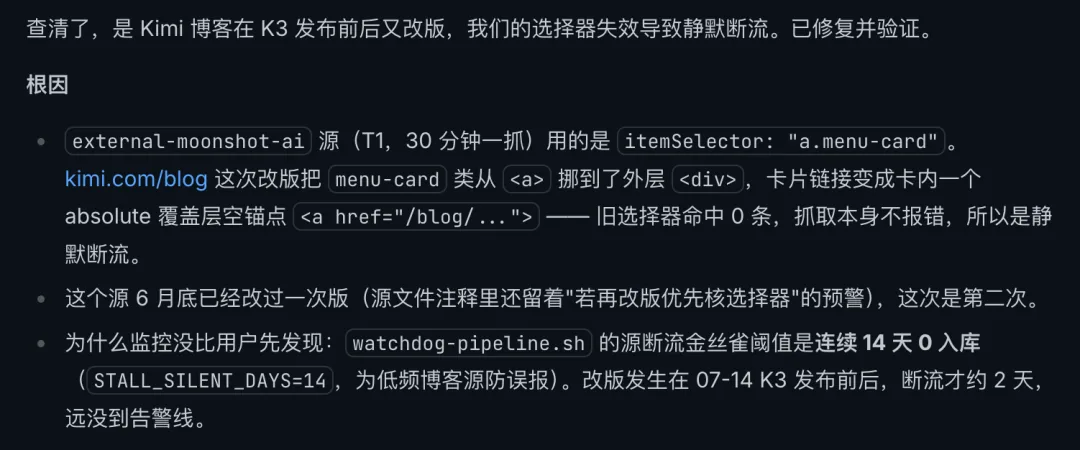 Then, realizing our alert system was set to notify us only after 14 days of data flow interruption, K3 decisively changed it to 3 days. It also fixed the blog scraping issue. The task was completed in 3 minutes, and the post correctly appeared on AIHOT.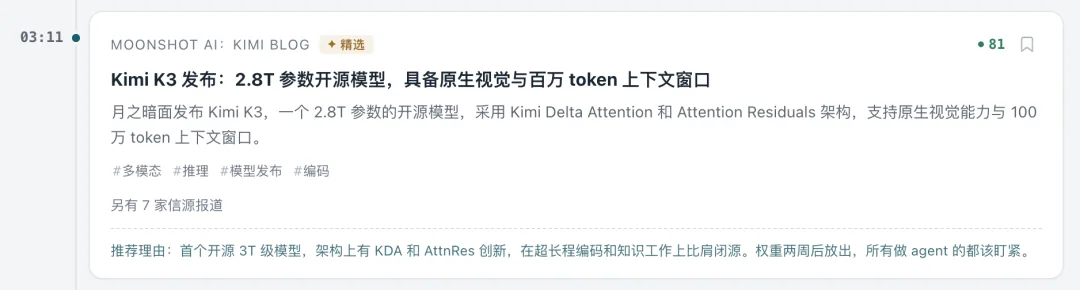
There was also a more complex task: optimizing AIHOT based on user feedback. My Feishu (Lark) channel pushes me user feedback submitted on AIHOT daily, like this.  Each feedback has a sequence number. I usually go through them daily and pass the valid ones to an agent to fix. I've been a bit busy lately and had accumulated a batch, so I decided to throw them all at Kimi Code at once.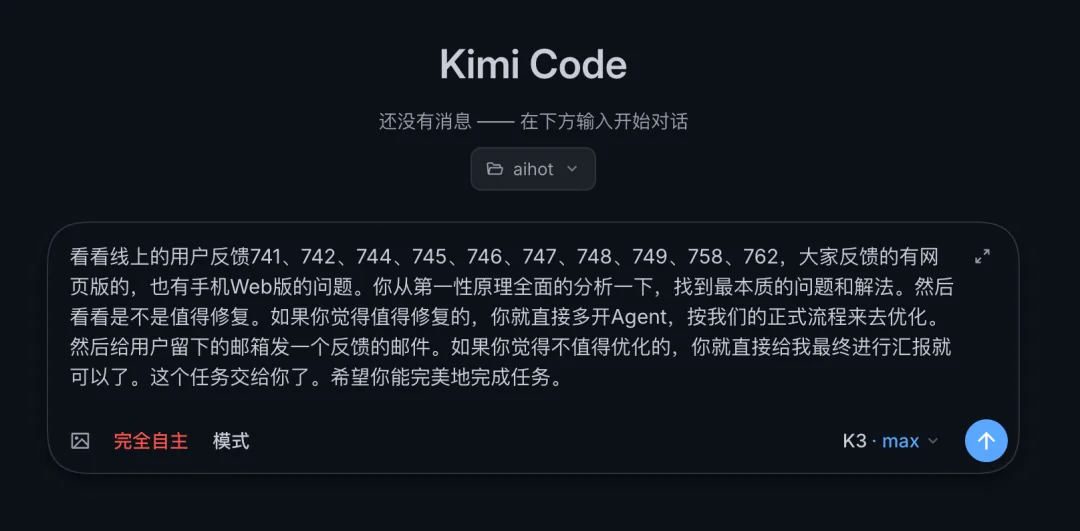
This task is both simple and complex. There were nearly 10 tasks, each quite different from the others. It also required solution design and judgment—not everything users say is correct—and tested long-horizon and multi-agent planning capabilities. I just sent them over.
It read my ops documentation, found my server connection details, logged in, and saw the user feedback. 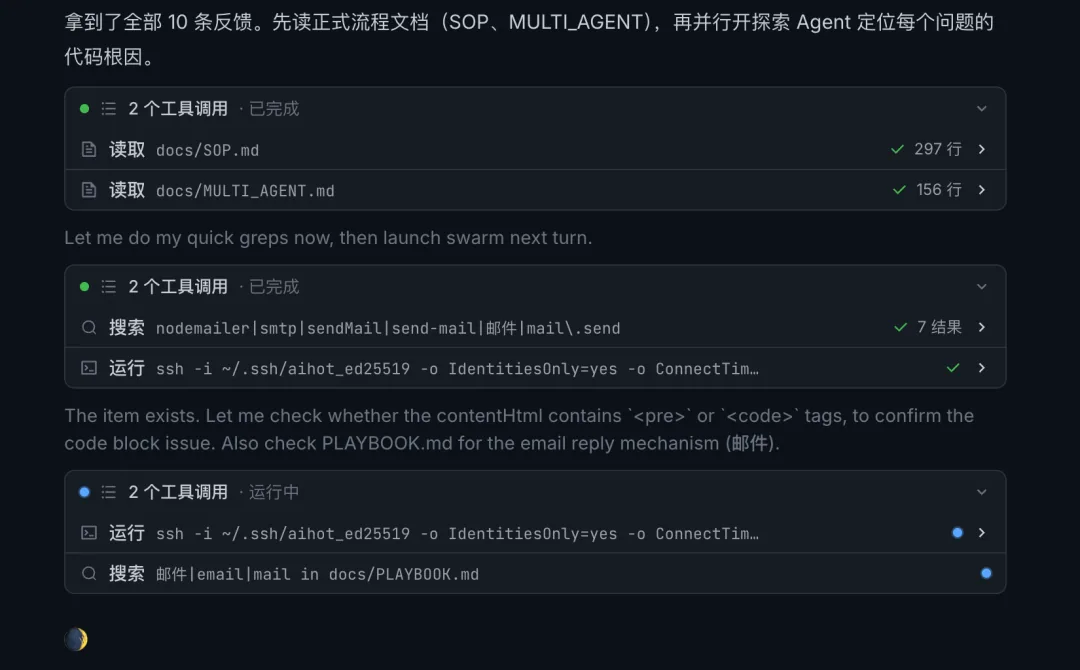 It then created a to-do list of 7 items.
 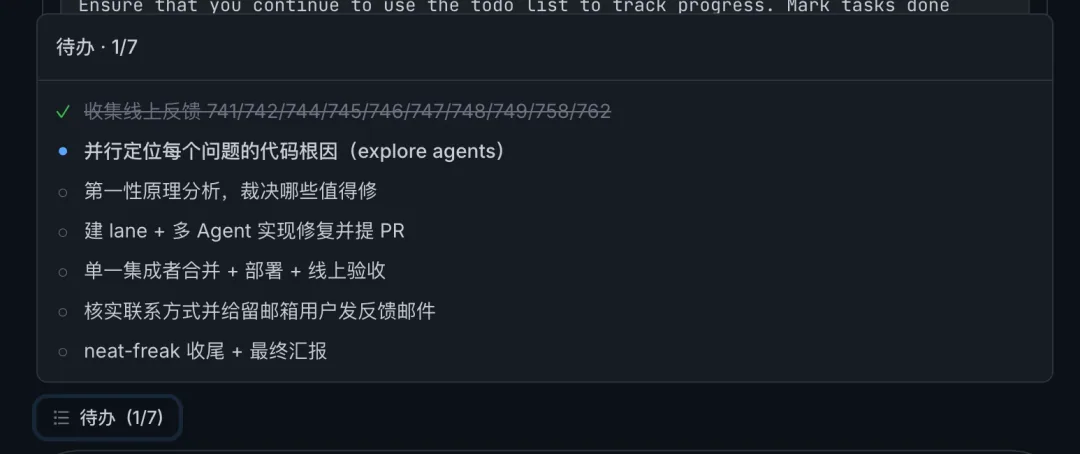 It launched 8 agents to begin research.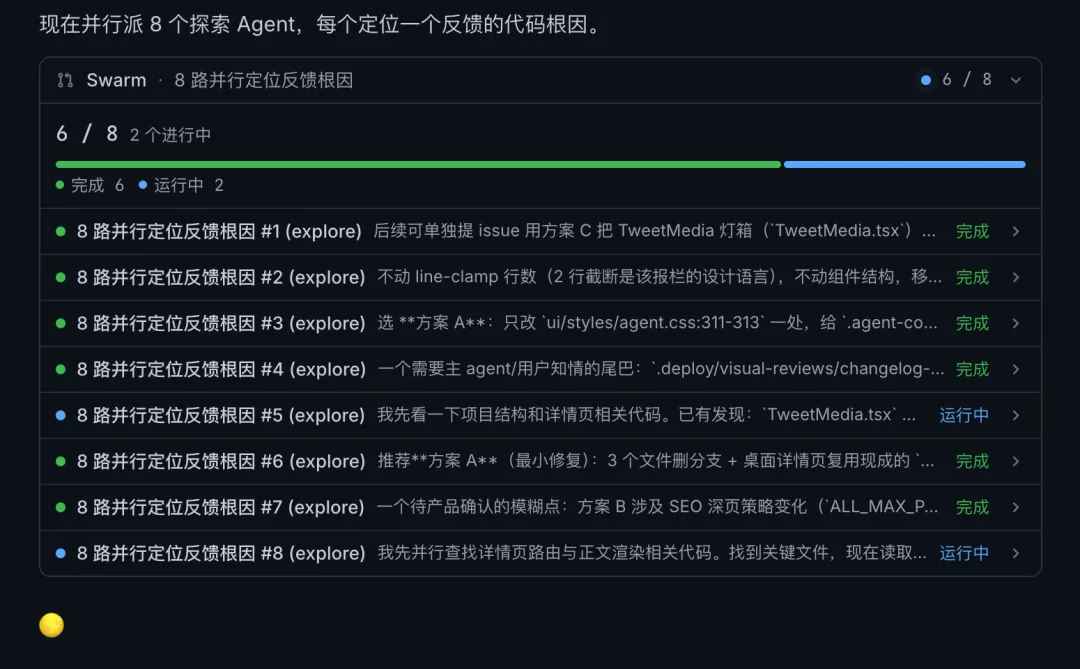
I have to say, Kimi's aesthetic sense is truly excellent. The UI display for Kimi Code is something I genuinely like—very clear and at-a-glance.
After research, it determined only 7 tasks were worth pursuing. It then opened 7 workspaces and launched 7 parallel agents to execute them. 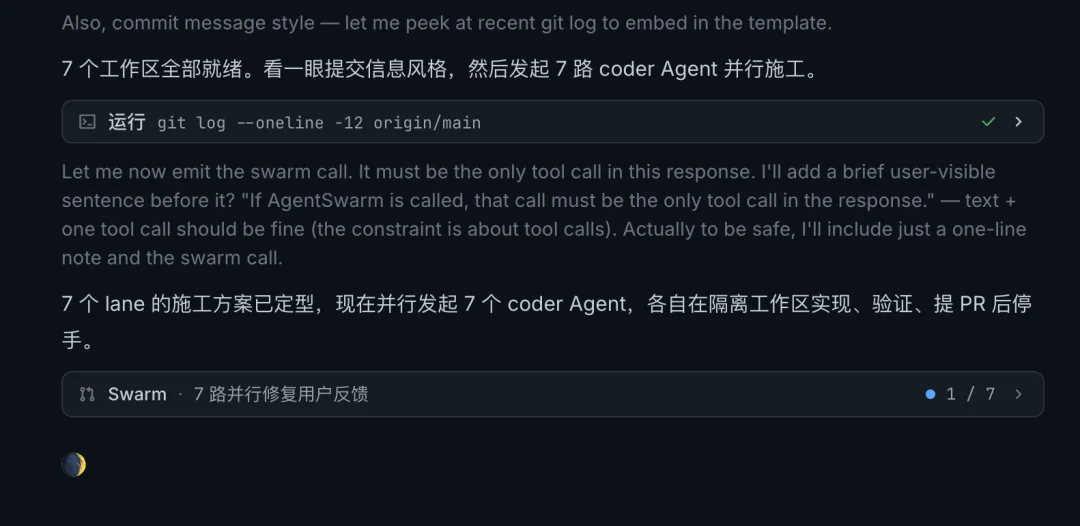 After about 1.5 hours of development, all tasks were completed, PRs were submitted, CI was passed, and the code was merged into the main branch.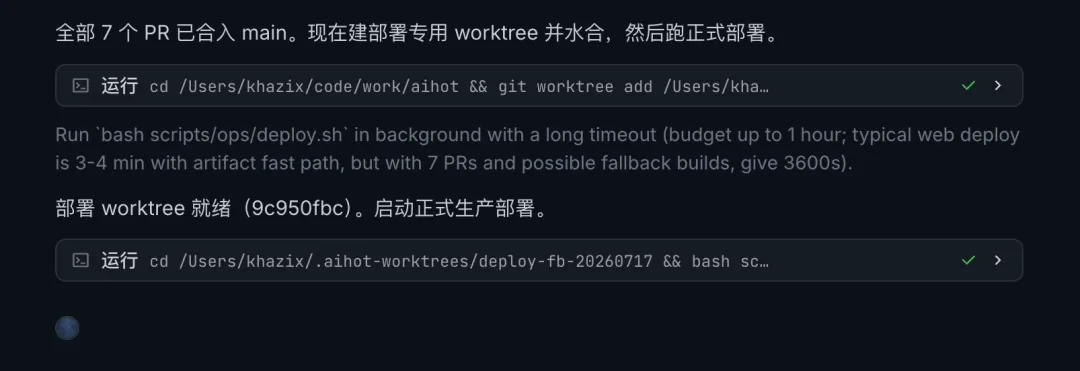
Two hours later, everything was done. 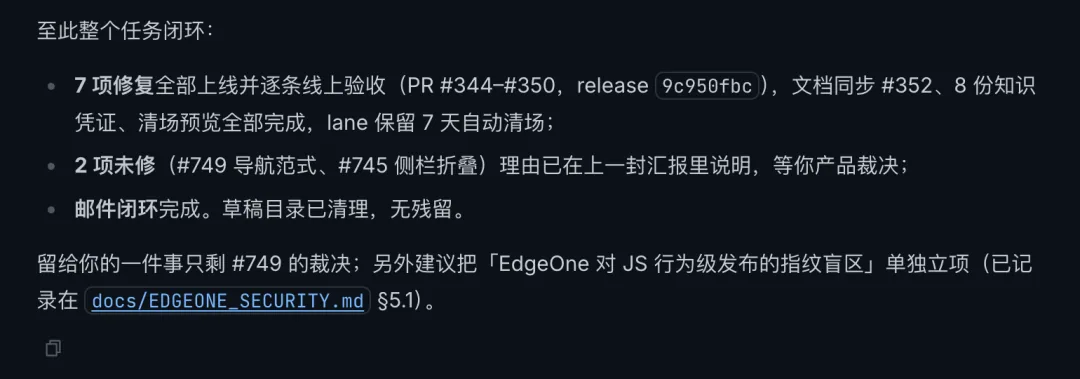 I checked my email, and sure enough, they had all been sent from my Feishu email address...
  The execution was excellent. The entire flow was completed without any bugs. The tasks that should be done were done, and for the two that weren't, it provided an explanation.
Beyond execution, I also tested its solution design. I pitted K3's proposals against GPT-5.6 Sol's and had Fable 5 judge them on several tasks. The result was about a 50/50 split with GPT-5.6 Sol, with different dimensions and aspects considered. For example, on a server performance optimization task, while Fable 5 ultimately chose Proposal #2 (Kimi K3's), it also noted that GPT's proposal had aspects Kimi missed. They're about equal; combining them would yield the best result. 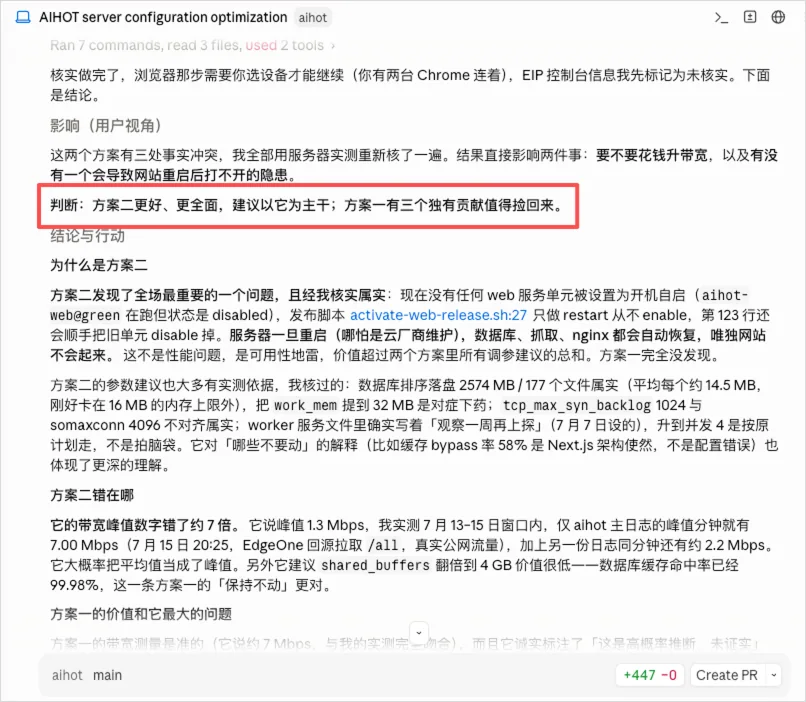
However, during testing, I did encounter one minor gap. K3 overlooked a detail that would normally have been caught in CI, leading to AIHOT having no new feeds for nearly an hour...
The detail itself was simple: I had it build a trending topics feature backed by about 500 trending sources. You can think of these as the "atmosphere group" monitoring our current 200+ curated sources, identifying what events are being discussed the most to surface trending topics.
K3 diligently completed all the tasks, pushed the PR, passed CI, and deployed it. But our website's system has performance limits. Each incoming piece of information goes through structuring, entity extraction, pre-screening, content cleaning, curated scoring, vectorization, event clustering, AI summarization, and so on, with several large model calls in between. There's a queue, and we can only process 6 items concurrently. Usually, a single item takes only 20-30 seconds, so we never have problems.
When K3 finished the trending feature, it also retroactively fetched the 500 trending sources using the rules for adding new sources, dumping 9,000 items into the queue at once. This completely clogged AIHOT's information processing queue. All subsequent curated items had to wait behind these 9,000, resulting in nearly an hour of no new scrapes on AIHOT...
It was just this one oversight regarding queue concurrency. But the underlying issue it revealed is that our current system can't handle more than 500 news sources concurrently, meaning the entire solution design needs to be reconsidered. This highlights a common limitation many models have in solution design.
However, I think this level of foresight is difficult for any model besides Fable 5. I tested GPT-5.6 Sol on the same scenario, and it completely failed to consider this as well.
Overall, in my several hours of testing, the precision and completeness in development met my expectations. It is the best domestically, bar none.
As for front-end tasks, that's Kimi's absolute comfort zone. The company has always had a strong aesthetic sense, and combined with K3's multimodal capabilities, this model represents another leap forward in front-end quality.
I must first show you two official front-end showcases—they're mind-blowing.
[Note: Original video content was present here, describing impressive spatial understanding and aesthetic front-end demos]
Watching these two videos, I feel no further explanation is needed. The spatial understanding capability is just too strong. The aesthetics on the flat design are also excellent.
I also used Kimi K3 to replicate some recently viral front-end effects. In terms of one-shot prompting, I personally believe the completion and aesthetic level of the output is second only to Fable 5.
For example, there was a particularly viral piece on Twitter recently featuring a building's eaves, with densely packed vertical text strands hanging down like beaded curtains. When you hover your mouse or swipe your finger, the text sways like a door curtain. 
I replicated it with K3. The prompt was also very simple. 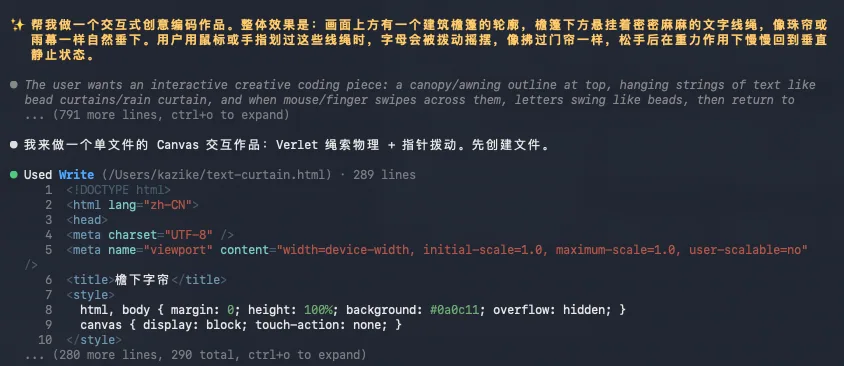 The first version already had the right idea—the overall shape was correct, but the details were still rough.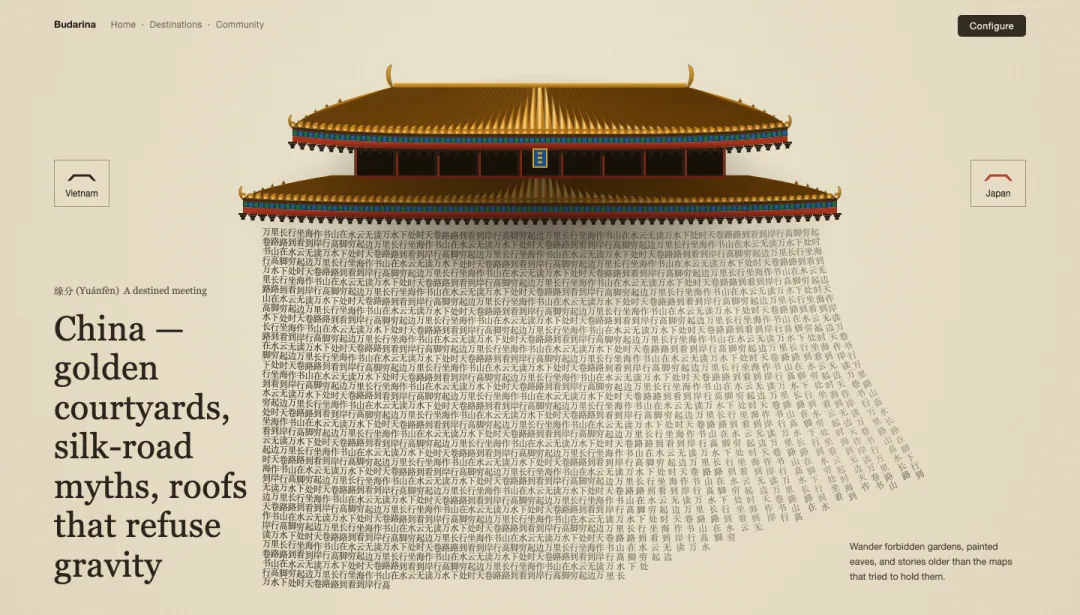
After I provided a few more hints, it was done.
[Note: Original video content was present here]
The effect is flawless.
There's also a wonderful piece from Xiaohongshu (Little Red Book) that I particularly love. 
I directly sent the tutorial screenshot to K3 and asked it to replicate it to see how well K3 performed. 
About 10 minutes later, it produced a first version. There were a few small details to optimize, so I used prompts to adjust the size and swimming speed of the pink fish and the number of blue fish, and I added a background music track.
Another 10 minutes or so passed, and you can see the result for yourselves.
[Note: Original video content was present here]
When the little pink fish was finally swept away and disappeared by the group of blue fish, I suddenly felt a sense of helplessness.
I also had GPT-5.6 Sol try to replicate this. 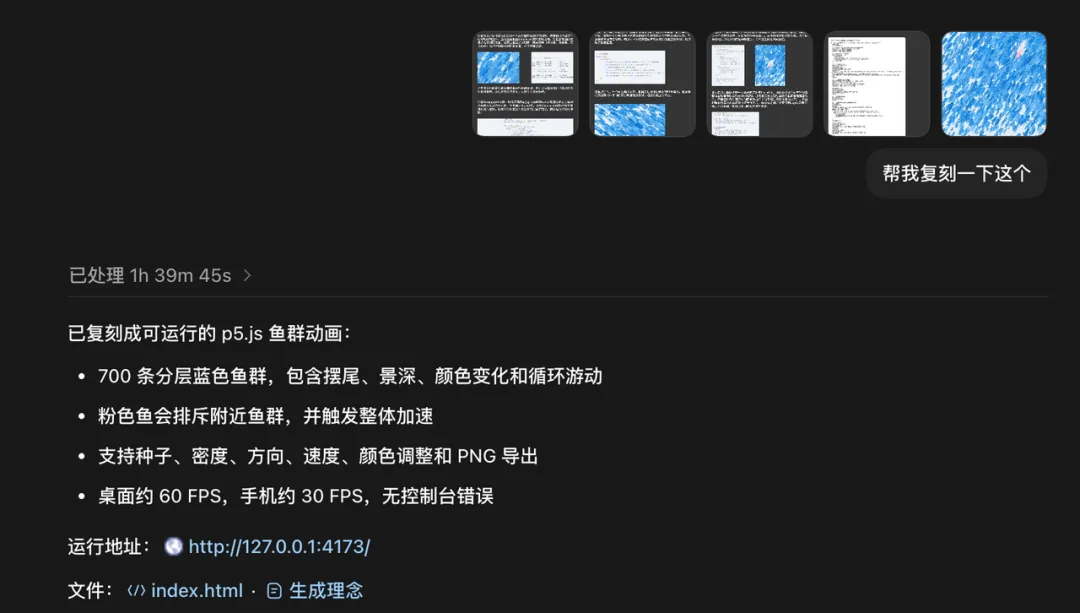
The result... 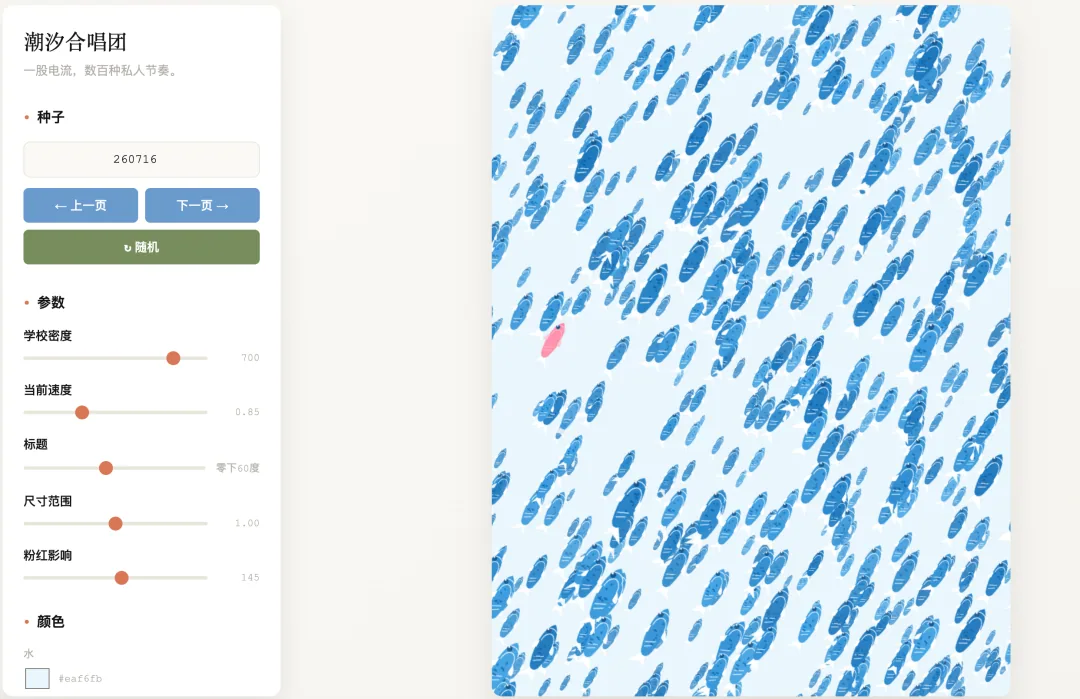
Let's just say, for GPT's aesthetic sense, we'll have to wait for GPT-6...
K3 likely has many more front-end tricks up its sleeve. I didn't have enough time to explore them all, but if anyone creates something cool, feel free to share in the comments.
Beyond coding and aesthetics, there's another area I know many people are concerned about—and I am too—and that's writing ability.
I tested this briefly. For example, I gave it the first large portion of my article "Designing Life" that I published last week, and asked it to use my "Skill" to continue writing the ending after the red line. 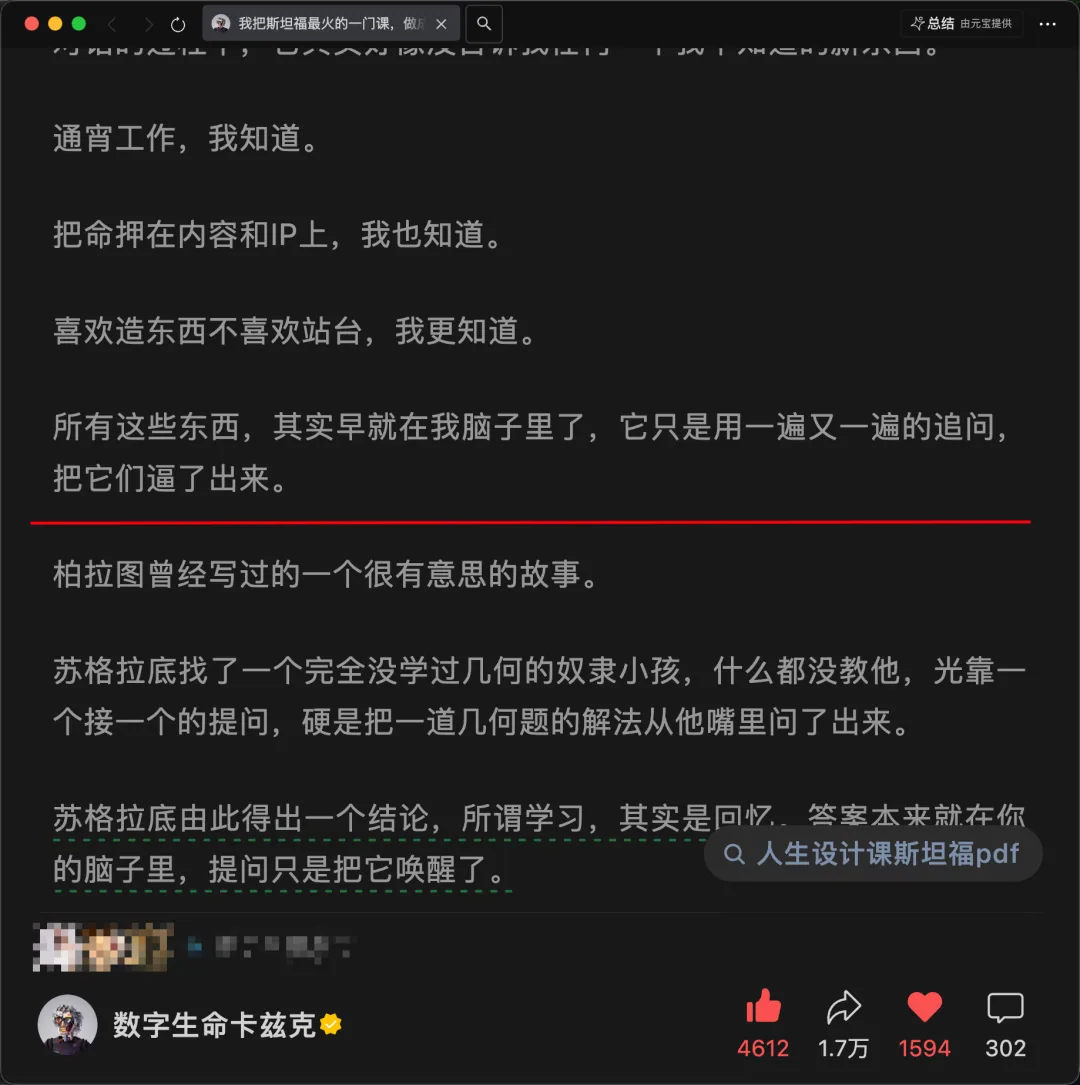
K3's ending was as follows. 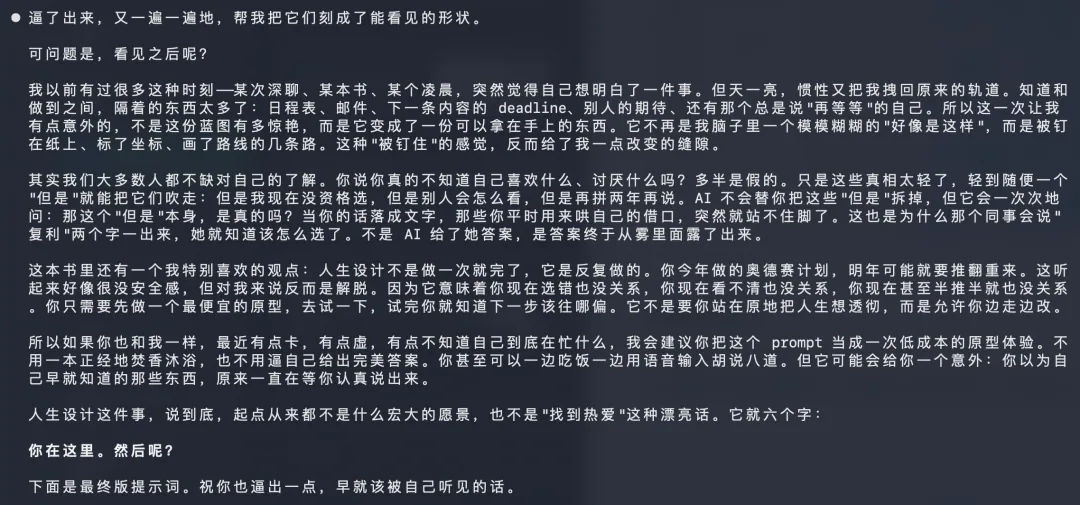
When I saw the final line, "I wish you could also squeeze out a little, something you should have heard from yourself long ago," I knew it was game over.
After testing several more examples, my conclusion is simple: if you can use Claude, the best writing model is still Claude Opus 4.6—it blows everything else in the world away. If you can't and are limited to domestic models for writing, then use DeepSeek V4 Pro.
Overall, K3 has surprised me immensely. It performed even better than I expected.
However, with such a massive parameter count, the price inevitably can't be low. The API pricing is essentially aligned with the Sonnet series. 
If you're thinking about buying a Coding Plan, you might want to hurry. Given computing constraints, I have a strong feeling it will soon be subject to purchase limits like GLM's plans, and you might not be able to get it. I shared this in my WeChat Moments today as well. 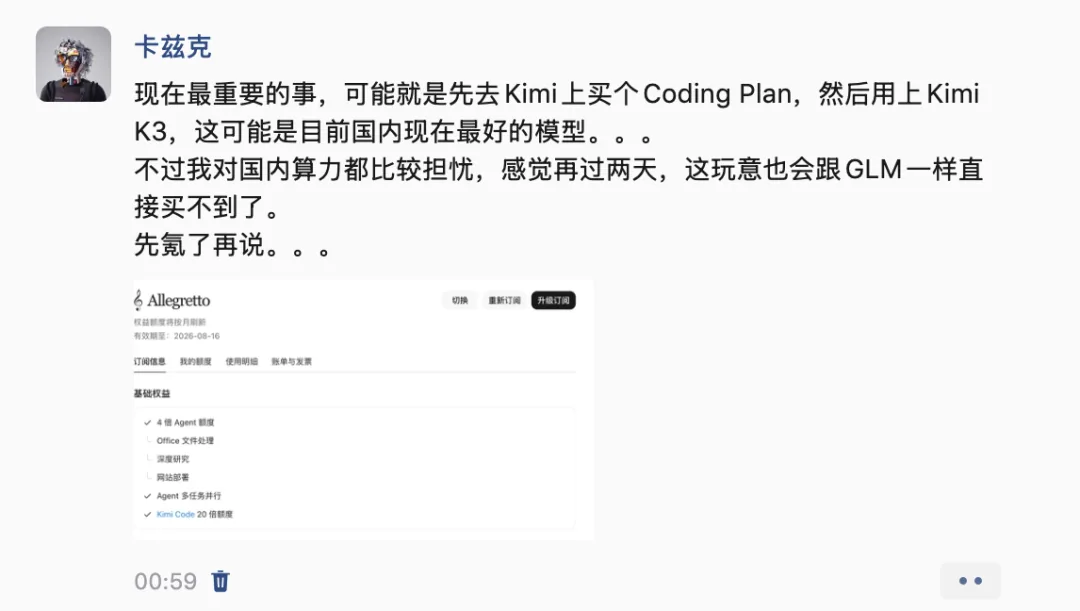
That's essentially the story with K3.
Let me end on a more personal note. When I first started creating AI content in 2023, the gap between domestic models and GPT-4 was, frankly, a chasm visible to the naked eye. Back then, talking about domestic AI carried a sense of "how do we even catch up?"
Over three years have passed, and the changes in this industry have exceeded everyone's expectations. Of course, we still have a gap compared to the top global models.
But now, we have DeepSeek R1's breathtaking debut, the stunning reversal of GLM-5.2's reputation overseas.
And today, we have Kimi K3.
I always think back to what Feng Ji said when DeepSeek R1 was released in 2025.
These are all part of a nation's destiny.
No matter the storms ahead,
the future is bound to be one of
national prosperity.
Editor's Take
K3's 2.8T parameter count is staggering, but I've learned to be skeptical of parameter inflation — Claude Fable 5 achieves SOTA with a fraction of that. The real test will be whether developers can actually deploy this cost-effectively. Kimi's commitment to full open-source weights, however, is genuinely commendable in an increasingly closed-weight landscape.
Loading...