Hands-On Review
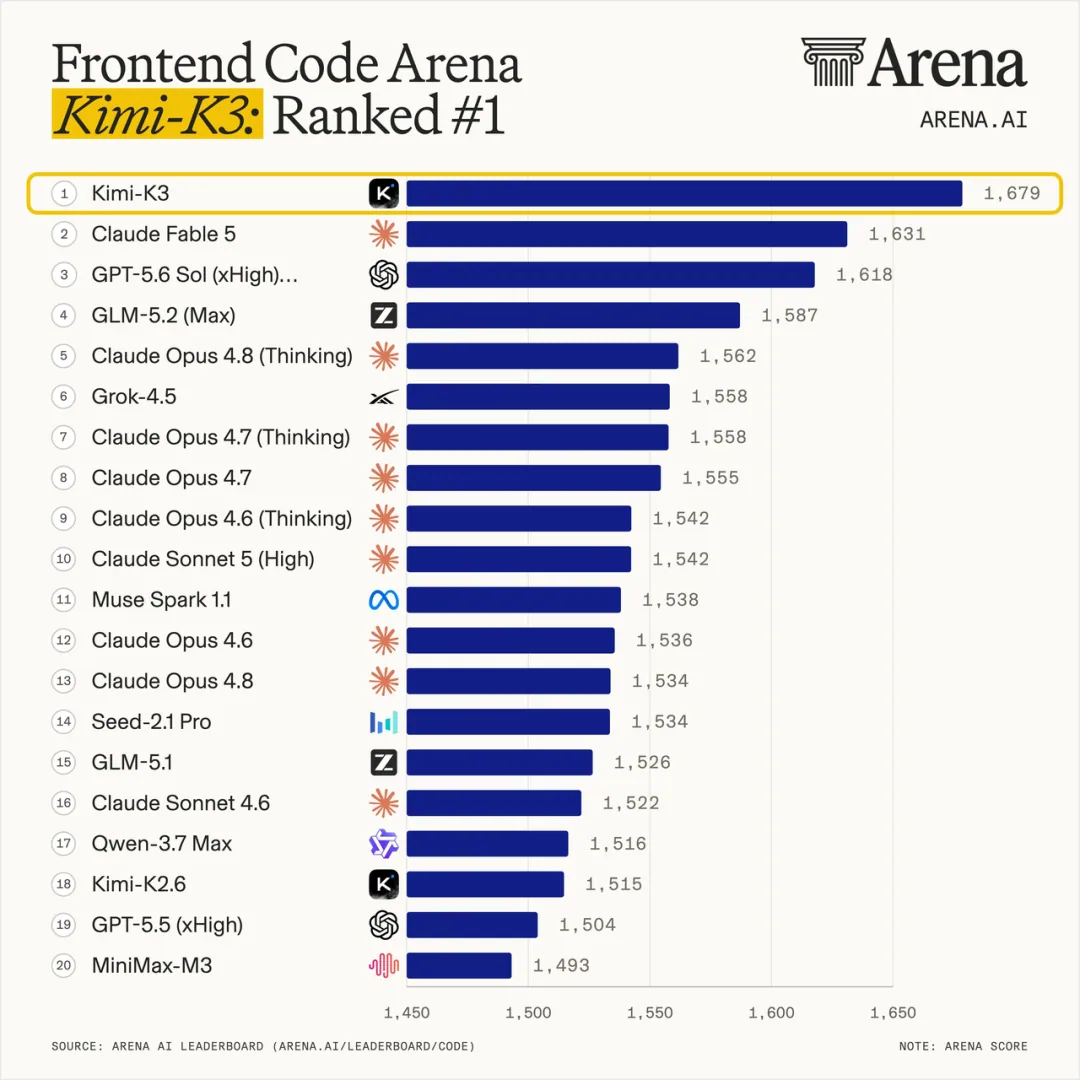
When I saw the Code Arena leaderboard update early this morning, my first reaction was surprise. The newly released Kimi K3 scored 1679 points, ranking first globally—surpassing Claude Fable 5's 1631 and GPT-5.6 Sol's 1618.

Code Arena primarily tests front-end programming, where models must generate web pages based on user prompts, focusing on visual fidelity, interaction design, and functional implementation. The results come from blind tests involving millions of users; for each task, two anonymous models are pitted against each other, and users vote after experiencing both outputs. Only after voting are the model identities revealed, minimizing brand bias and adding credibility to the results. In other words, at least in front-end coding scenarios emphasizing visual presentation and interaction, K3 now sits at the very top.
An open-source model just released, effortlessly outperforming several closed-source flagships—it almost seems too good to be true. So, we decided to put Kimi K3 through a rigorous overnight test to verify its mettle. Fun fact: the video below isn't an official promotional clip but an animation regenerated by K3 based on the original trailer provided by APPSO.
From reconstructing the webpage visuals and handling camera movements, effects, and interactions, the entire process was completed by K3. Making a model create an introduction animation for itself serves as a highly intuitive opening test. Especially given the recent fierce competition between Fable 5 and GPT-5.6 Sol, with capabilities rising and token consumption soaring, many were awaiting Claude Opus 5—only for Kimi to unveil a 2.8 trillion parameter open-source model.
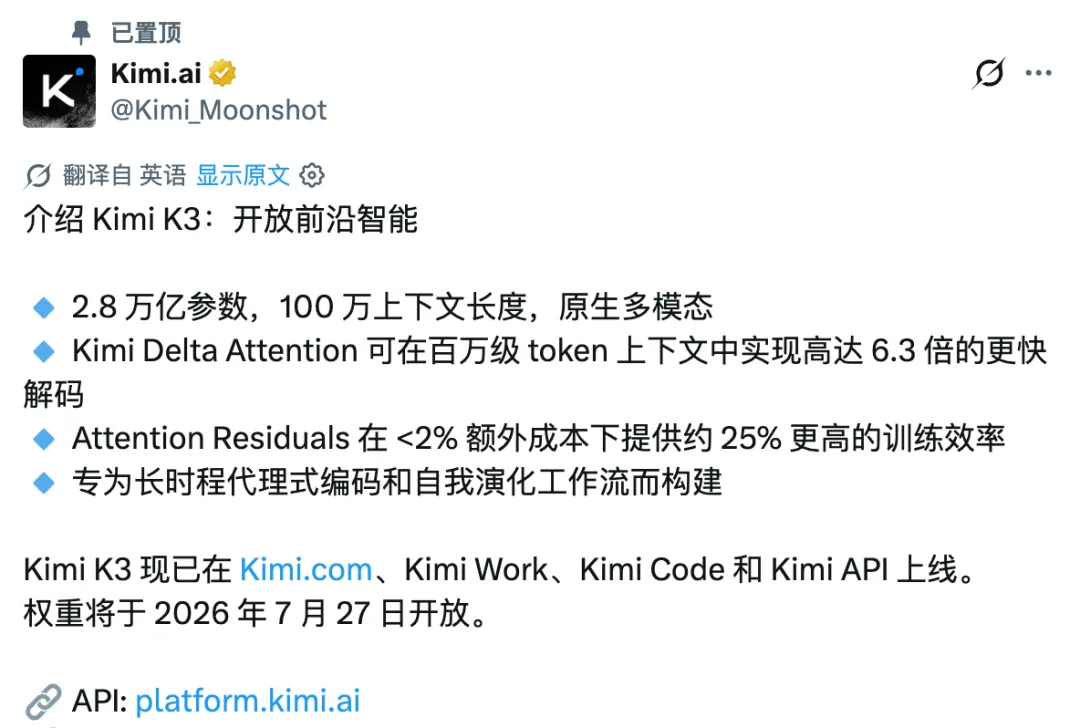
Yes, 2.8 trillion parameters—and it's open-source. Kimi K3 is the world's first open-source model in the 3 trillion parameter range, featuring a 1 million token context window, native visual understanding, and a focus on long-horizon programming, knowledge work, and reasoning.
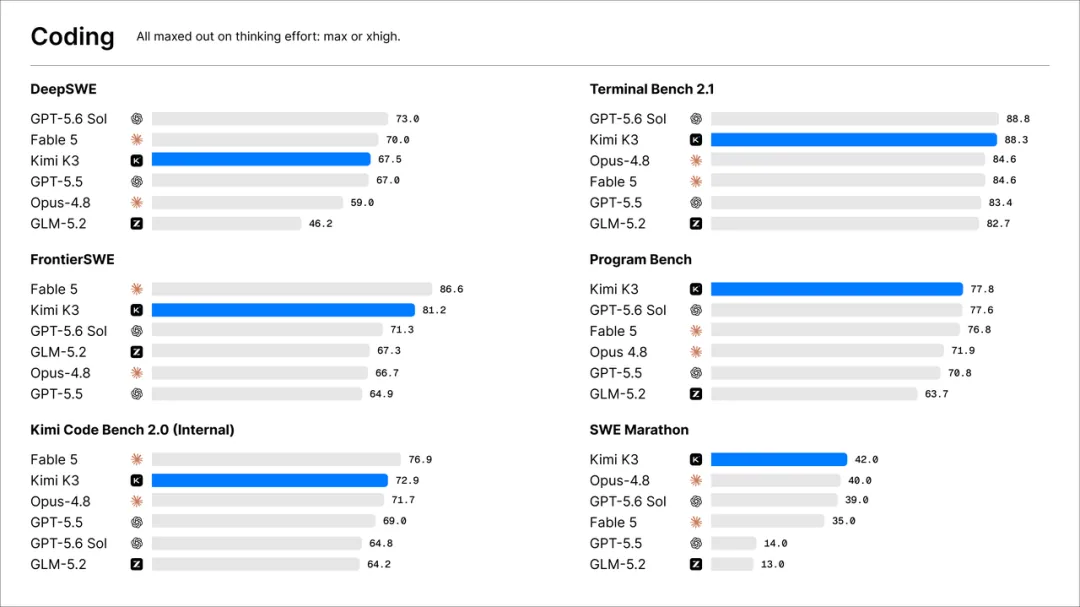
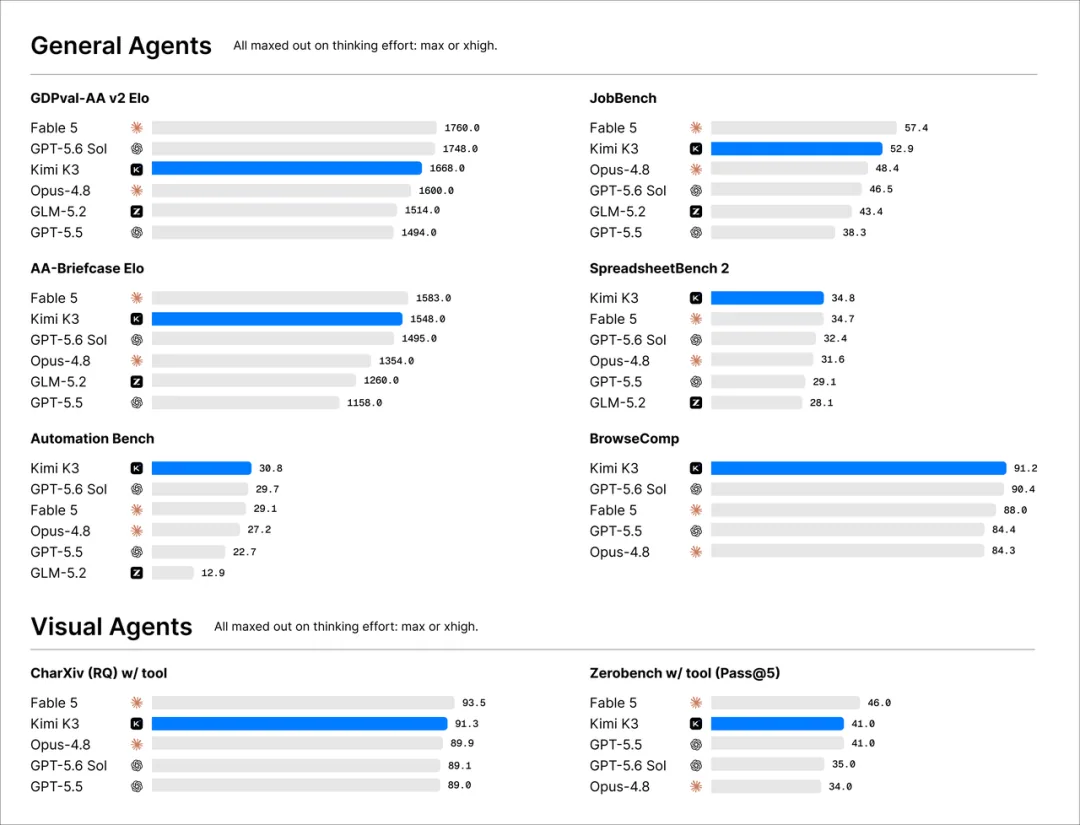
While closed-source flagships are incremental upgrades, the open-source side has pushed parameter scales to a new ceiling. More intriguing is this line from the official blog: "Although Kimi K3's overall performance still lags behind the strongest closed-source models Claude Fable 5 and GPT-5.6 Sol, it demonstrates frontier-level capabilities across our full evaluation suite and stably outperforms all other models." Such candor is a refreshing change in the Chinese large model landscape.
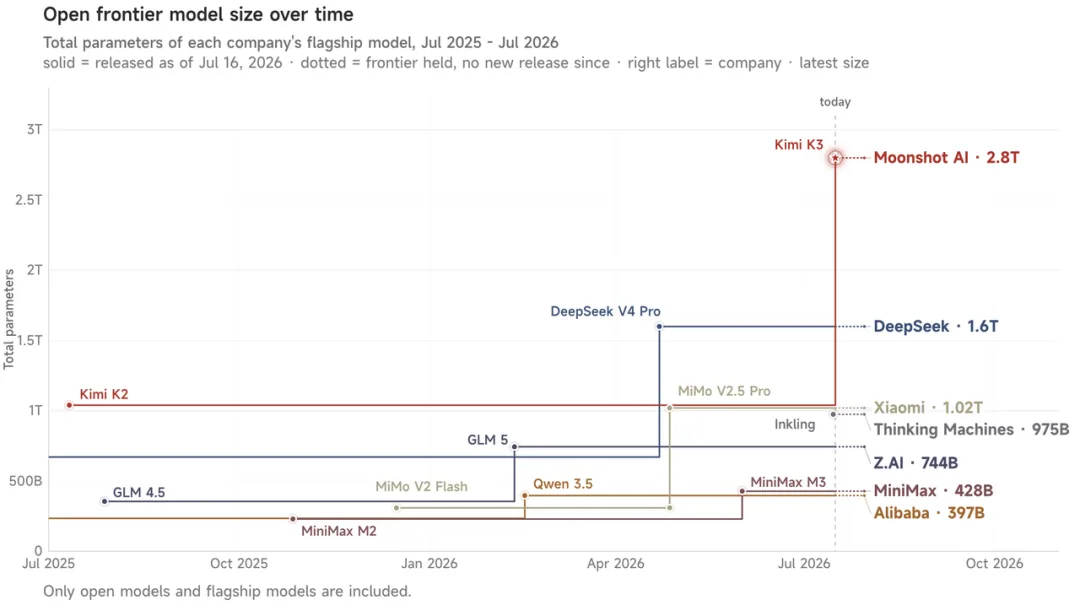
But humility aside, K3's capabilities are substantial. How was this 2.8 trillion parameter beast tamed? Over the past 12 months, for 9 months, the upper limit for open-source model scale was held by Kimi. K3 is the latest step on this path. Architecturally, K3 introduces two key innovations: Hybrid Linear Attention (Kimi Delta Attention) and Attention Residuals. Simply put, the former prevents the model from being bogged down by computational load when processing ultra-long sequences, while the latter ensures information isn't "distorted" as it passes through hundreds of layers in the deep network. One handles technical length, the other handles technical depth—together supporting parameter scales beyond the trillion level.
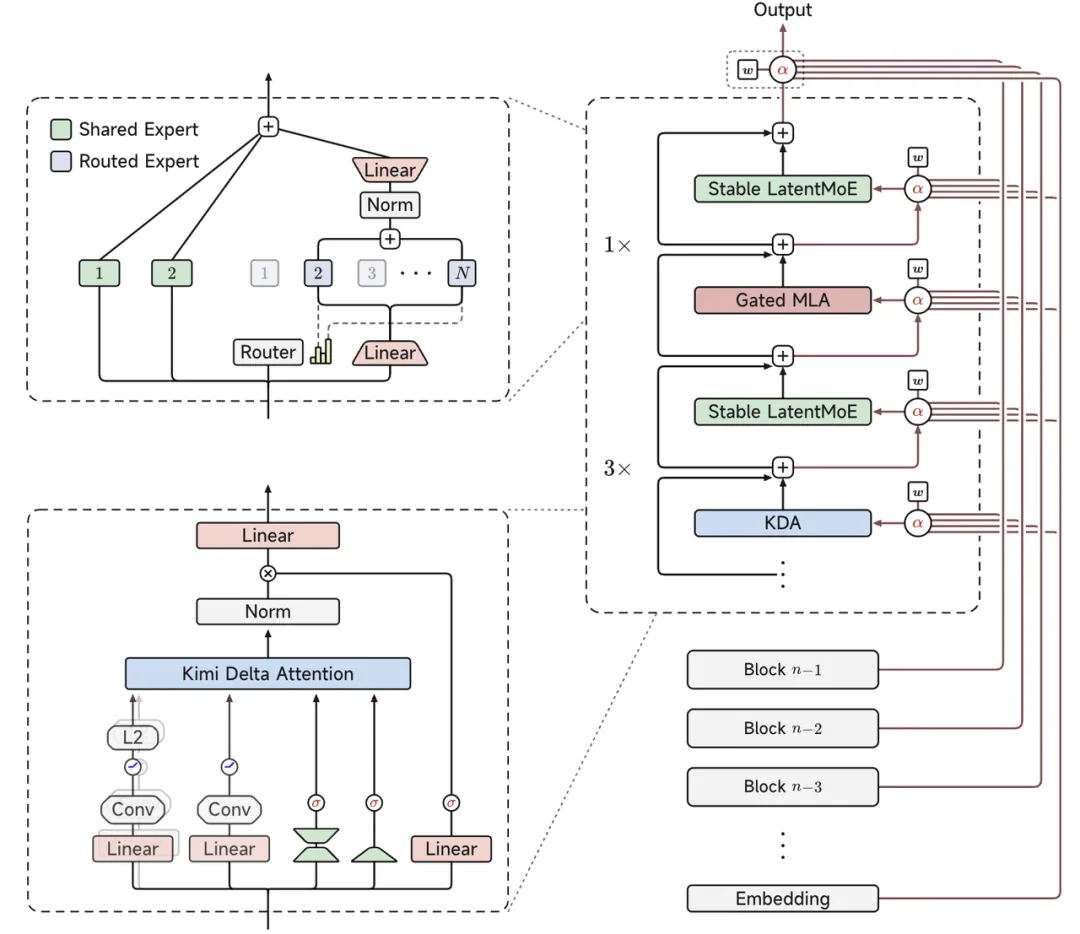
The Mixture-of-Experts (MoE) sparsity further enhances efficiency: 896 experts, with only 16 activated at a time. Combined with optimizations in training methods and data recipes, Kimi claims K3's overall scaling efficiency improved by about 2.5x compared to K2. The same computational power now yields more capability.
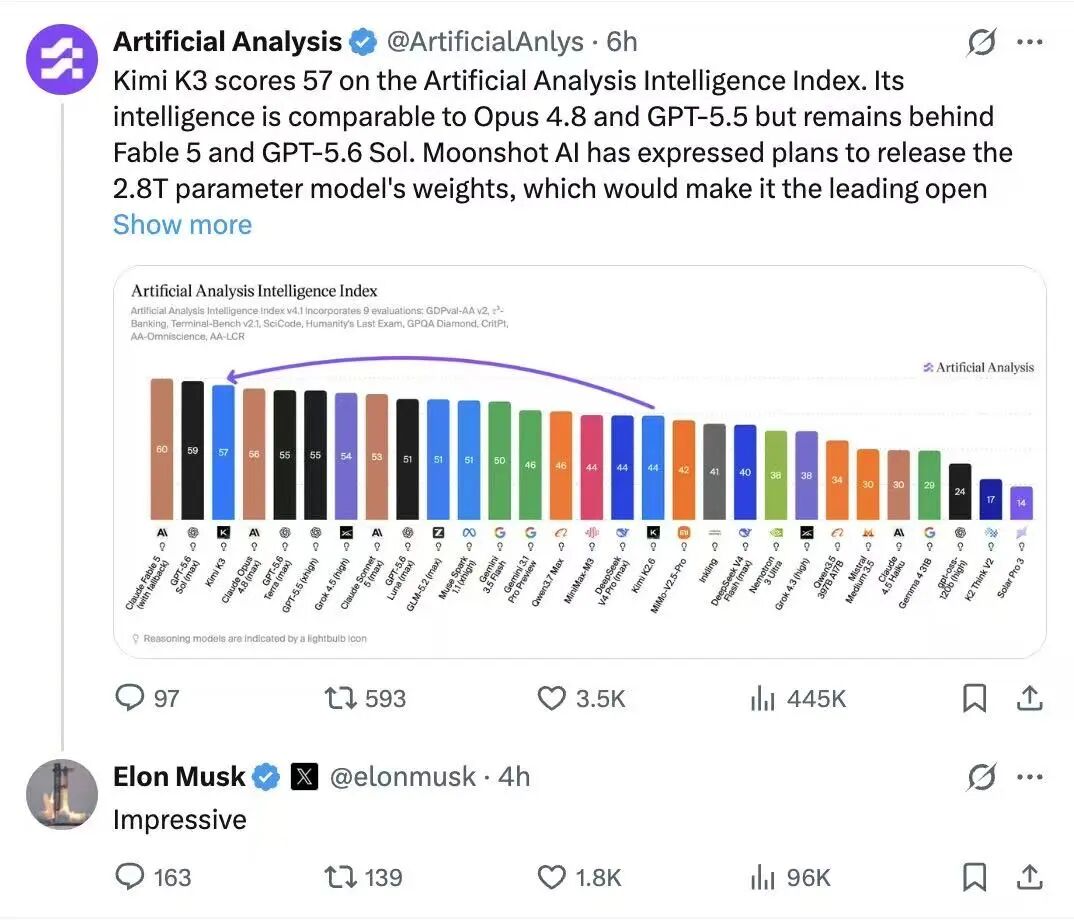
On the Artificial Analysis Intelligence Index covering reasoning, coding, and knowledge, K3 ranks third with a score of 57, behind only Claude Fable 5 and GPT-5.6 Sol, while leading models like Claude Opus 4.8 and GPT-5.5. This track record even caught Elon Musk's attention, who commented in a thread: "Impressive."
Looking at both leaderboards together, K3 still has a gap to the most comprehensive closed-source models, but it's highly competitive on the primary battleground of coding. With such a powerful model, your first reaction might be: how expensive is it to run? Kimi clearly anticipated this. K3 underwent quantization-aware training from the SFT stage, using MXFP4 weights and MXFP8 activations, making it natively compatible with low-precision hardware. Expert parallelism training is fully balanced with static shapes, and critical paths don't require host synchronization. To address challenges posed by KDA to traditional prefix caching, Kimi contributed the implementation to the vLLM community, open-sourced alongside the model.
Regarding pricing, we believe Chinese models shouldn't always compete on low prices alone; there should be companies responsible for "high volume and affordability" and others that can challenge the pricing power of Anthropic and OpenAI. This time, K3 matches or even surpasses Opus in performance, occasionally reaching Fable levels, with official API input and output prices at 20% of Fable and 40% of Opus—essentially undercutting Anthropic's pricing. Considering the model will be open-sourced in 10 days, allowing capable companies to deploy it themselves, and the reality of Chinese AI companies generally lacking computing resources, this pricing is even more intriguing. However, API prices are less relevant to ordinary users; monthly subscription plans, when fully utilized, are typically 5 to 10 times cheaper than API rates.
Now, for the most critical question: how tough of a job can it handle? We prepared five diverse tasks for K3, ranging from physics simulation and procedural modeling to complex management systems, as well as aesthetic-driven Eastern fantasy scenarios. Making beautiful visuals is just passing grade—the underlying numerical changes, state evolution, and interaction logic must also hold up.
Penalty Kick Simulation: In this year's World Cup, penalty kicks became decisive in many matches; even stars like Messi miss them. I wanted to use AI to calculate the optimal penalty kick angle for the highest goal probability. K3 converted variables like player touch, shot angle, ball speed, and goalkeeper reaction into a credible computational model, then conducted large-scale Monte Carlo simulations based on public data, comparing success rates across strategies to answer the ultimate question: without exceeding a professional player's real ability limits, how should the ball be kicked to make it hardest for the goalkeeper to save?
K3 calculated the theoretically toughest shot: v₀ ≈ 25 m/s + side spin ≈ 8 rev/s + mid-height off-center placement, with a goal probability of ≈89%. We strongly recommend Messi read this article before the final.
Chocolate Factory World: The second task involved building a chocolate factory garden world from scratch using Three.js—chocolate rivers, caramel waterfalls, candy gardens, copper vats, conveyor belts, and miniature workers—all procedurally generated without external assets, with workers having realistic task queues and path networks instead of just posing statically.
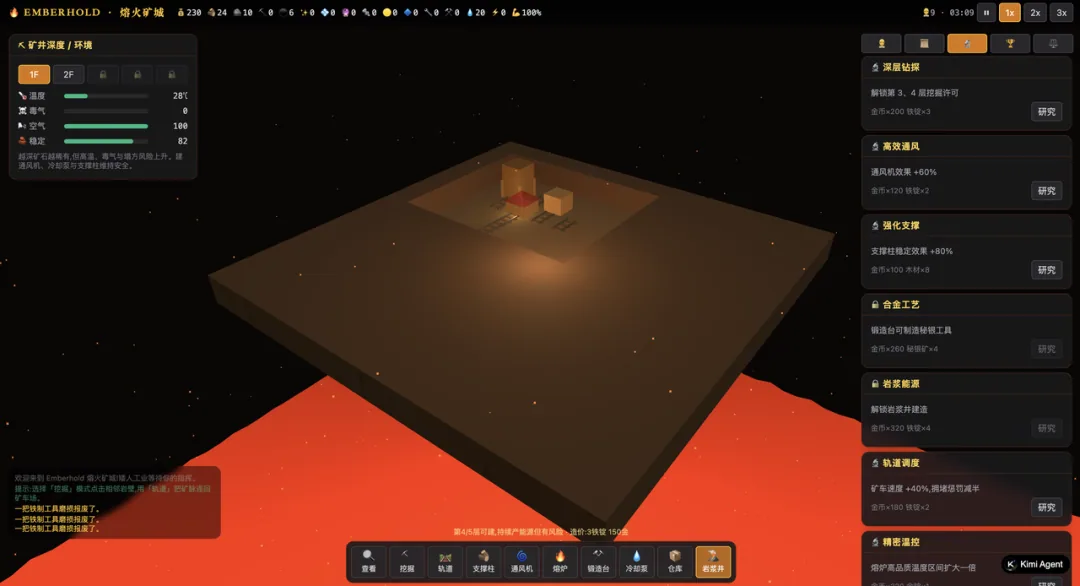
Emberhold: Molten Mine City: This procedural modeling task added management and risk systems: multi-level mines, rail carts, smelting forges, ventilation, and collapse systems all interconnect; digging deeper yields rarer minerals, but temperature and collapse risks rise simultaneously, and rail carts must follow actual tracks.
Underwater Volcano Eruption: A more challenging task pushed the boundaries with an underwater volcanic eruption. K3 needed to use Three.js to present in real-time the entire process of an island emerging from the sea: lava fountains tearing the surface, steam, ash, lightning, giant waves, and a research vessel moving simultaneously, with the coastline growing as lava cools, collapses, and erodes. The difficulty lies in maintaining multiple dynamic systems and providing a timeline from seabed bubbling and eruption to island stabilization and life emergence, along with various observation angles from the ship, helicopter, coastline, and crater. Visual scale, physical changes, interactive control, and runtime performance are all essential.
Eastern Fantasy Ink Scene: After testing hard skills, we evaluated its aesthetics. In this Eastern fantasy ink-style oil-paper umbrella scene, rain on cobblestones, water surfaces with floating umbrellas, light projections, flowing patterns on umbrellas, and a controllable character jumping interactively create a dreamy, dynamic effect.
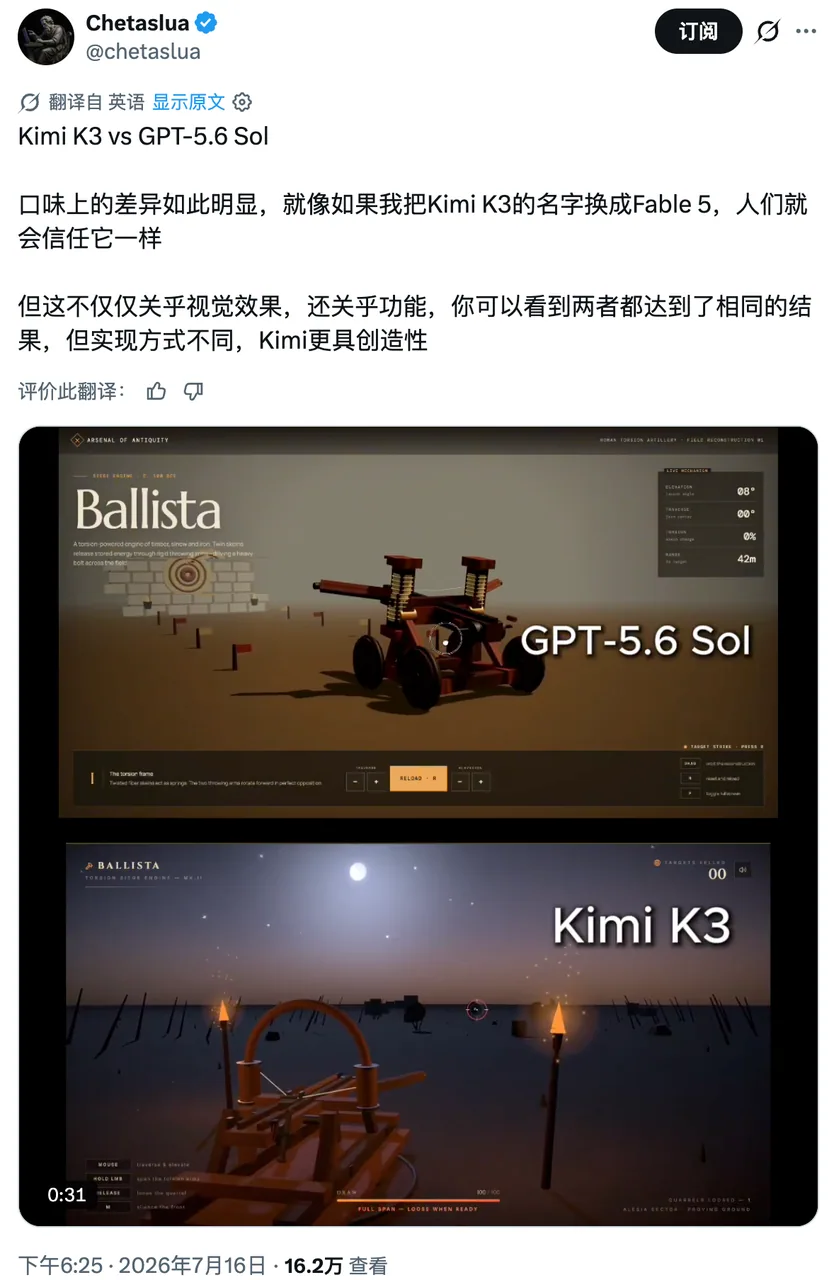
X user @chetaslua noted that while K3 and GPT-5.6 Sol achieved similar results, K3's implementation showed better design taste and creativity.
Beyond visually stunning demos, I used Kimi K3 to develop a focus app with a one-sentence prompt: replicate Forest but with a more refined interface and animations like Focus Flight. Hours later, it actually delivered, reaching a playable product prototype level—a task that might take a front-end developer two to three weeks.

The app is called "Aeris" (云驰 Aeris); opening it reveals a dusk-colored hangar with a plane on the runway awaiting route selection. It replaces Forest's tree-planting focus mechanic with flight, but it's not just a reskin: focus duration equals flight time, with different white noise options; after boarding, dynamic cruising begins; quitting mid-flight triggers a return, and completing the journey accumulates mileage and unlocks new destinations. From branding and visual style to interaction and growth systems, it's remarkably complete.
While writing this article, I've taken a few more flights. APPSO has shared the link for everyone to try: https://lamuxcg4s74za.ok.kimi.link/#/
The K3 Moment for Open-Source Models: More commendably, the official blog shares their reflections. K3 is sensitive to historical thinking content; it uses a thinking history preservation mode throughout post-training. If an Agent framework doesn't return all historical thinking content as required, or if you switch mid-session from another model, generation quality may be unstable. Official advice is to use verified compatible frameworks like Kimi Code and avoid switching models mid-session. It can also be overly proactive; since training emphasizes long-horizon, high-difficulty tasks, it might make unexpected decisions for small problems or ambiguous user intents. To keep it in check, set rules in the system prompt or AGENTS.md. This honesty alone earns a positive note.
Speaking practically, the world's largest open-source model doesn't automatically mean the world's strongest. 2.8 trillion parameters don't directly prove K3 surpasses top closed-source models. Ultimately, whether a model can handle complex engineering depends on usage cost, task stability, and real-world deliverables.
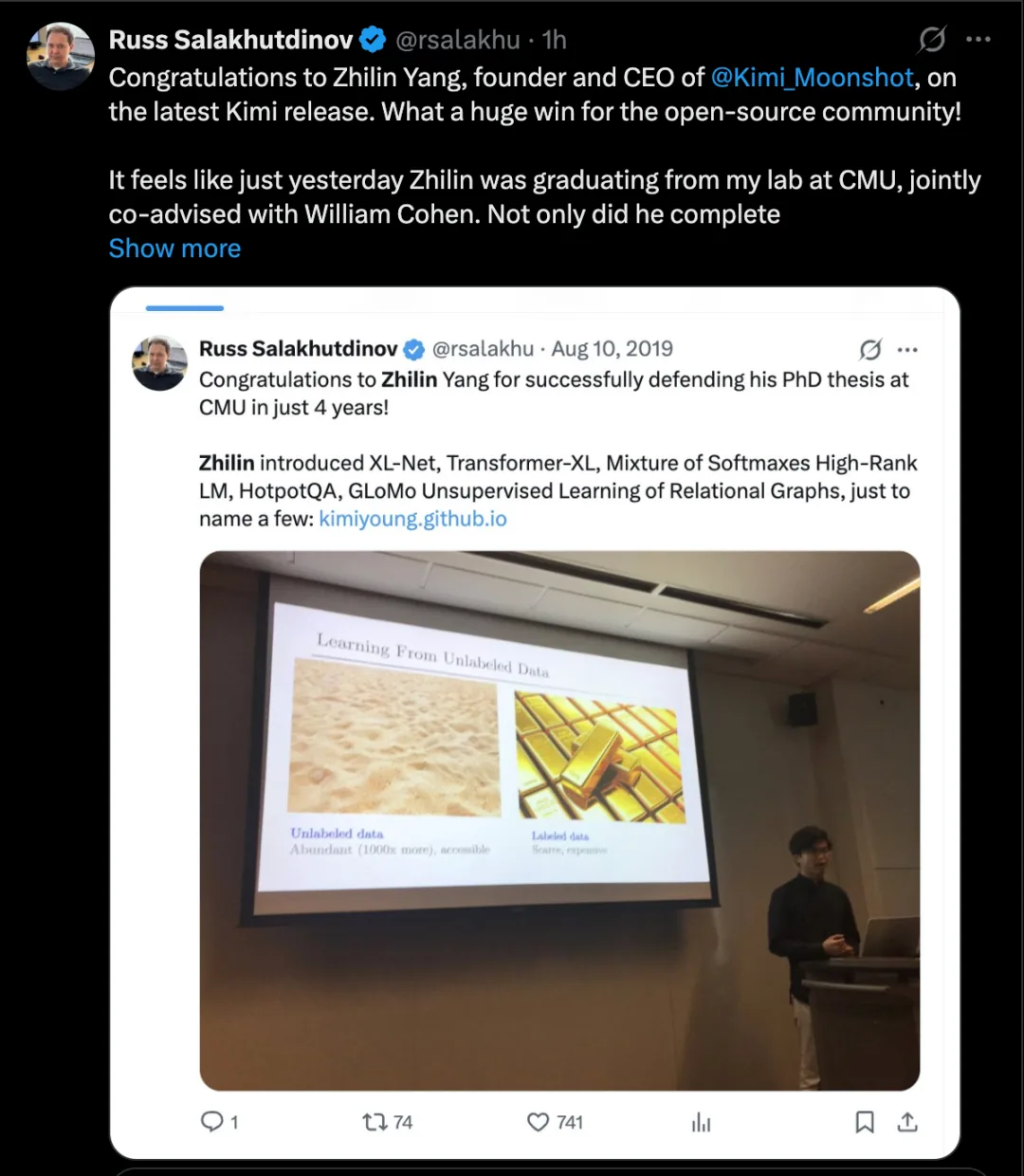
Easter Egg: Moonshot AI (Kimi) founder Yang Zhilin's CMU advisor, Russ Salakhutdinov, posted congratulations—Russ is also a direct disciple of Hinton and Apple's first AI director.
But K3's emergence has changed at least one thing. In the past, open-source models followed closed-source flagships, replicating existing capabilities at lower prices. Now, they're actively pushing scale to new limits, tackling million-token contexts, long-horizon programming, and complex Agent tasks, directly competing in the race for next-generation model capability boundaries. On X, some have called Kimi K3 another DeepSeek R1 moment, but after our overnight hands-on experience, APPSO believes that in the open-source model world, K3 fully deserves its own name. 2.8 trillion parameters are just an entry ticket. Opus 5 hasn't arrived yet, and open-source models have already reshuffled the deck—I call it the K3 moment.
Editor's Take
After hands-on testing through the night, my takeaway is that benchmark scores and real-world developer experience still don't fully align. A 1679 Code Arena score is impressive, but production code stability is a different beast. That said, an open-source model reaching this level is historically significant — the gap between open and closed is genuinely closing.
Loading...